
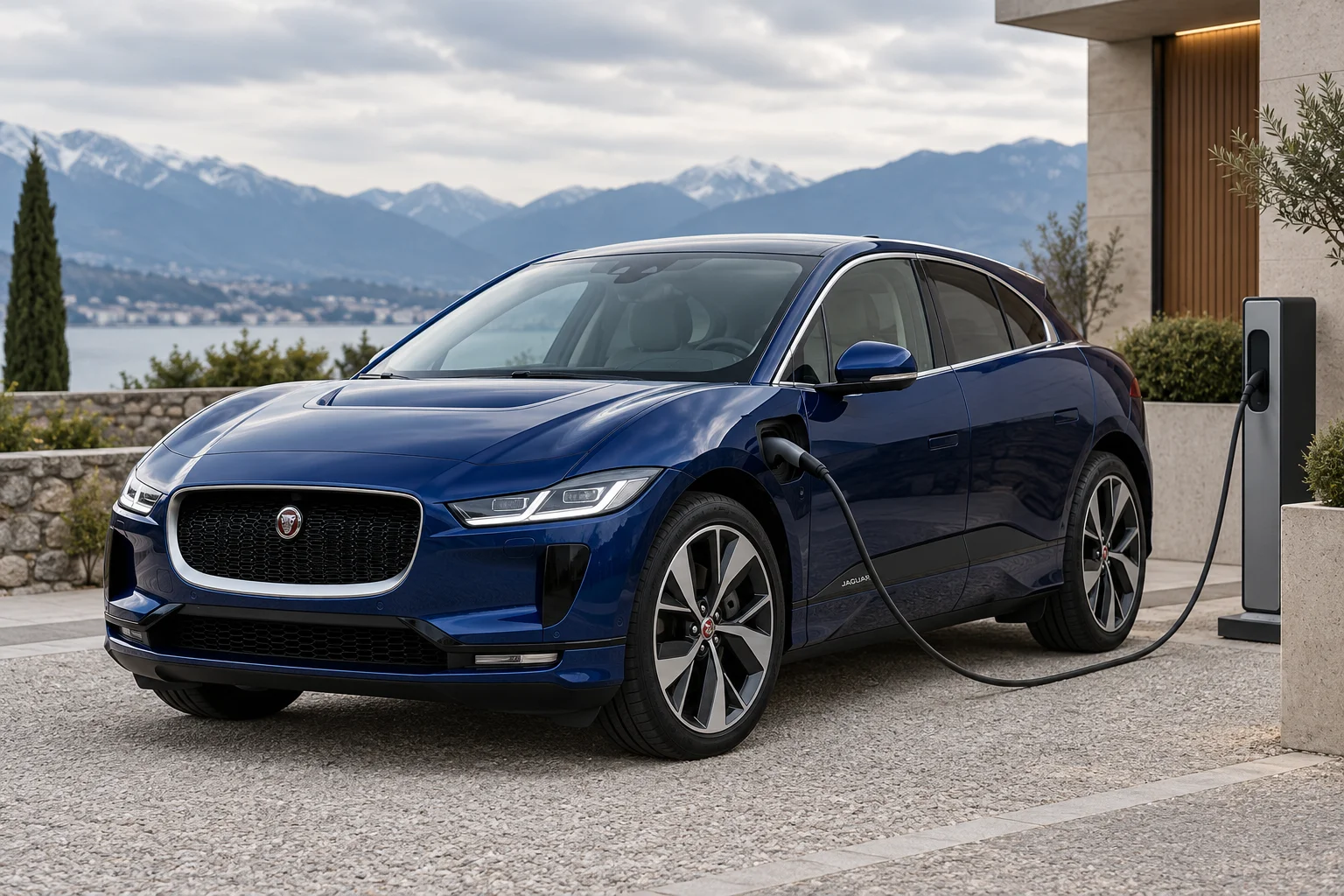
Jaguar I-PACE: two ongoing cases involving recalls, charge limits and contract termination
By Mag. Patrick Maydell, LL.M. – lawyer and trained automotive mechanic
Last updated: 31 October 2026
I currently represent two buyers of Jaguar I-PACE vehicles whose cases involve high-voltage battery problems, safety recall H570 and a 90 per cent charge limit. I am seeking to reverse the purchase in both cases. The cases share some features, but differ in their repair histories, evidence and procedural progress.
Claims have now been filed in court in both cases. The outcome of both proceedings remains open. Drawing on these ongoing matters, I explain the technical and legal questions that can be decisive for affected buyers, without anticipating a court decision.
Two Jaguar I-PACE vehicles, two different starting points
Case 1: a battery module was replaced, but the charge limit remains
In the first case, a defective module in the high-voltage battery was replaced following charging problems. A measure relating to safety recall H570 was also carried out. According to my client's latest report, the vehicle nevertheless remains limited to a maximum state of charge of 90 per cent.
In the ongoing court proceedings, I argue that replacing the defective module does not resolve the separate question of the recall and the remaining restriction. The issues include how the charge limit affects use, what remedy is actually available and whether the conditions for the requested termination of the contract are met.
I distinguish between the individual technical questions. A module defect and a safety measure affecting the same battery pack do not establish that they have the same cause. Whether a defect was already inherent at a particular point in time is also a question of evidence. I have requested an expert report on these issues. There has been no final judicial determination.
Case 2: battery work and a charge limit before the purchase
In the second case, a workshop record documents replacement of the high-voltage battery and a measure concerning the charge limit in connection with H570 before the sale. Shortly after taking delivery, the buyer complained that the Jaguar would charge only to 90 per cent. In the exchange with the seller at that time, reference was made to a future update.
An air-conditioning failure and an insulation fault in the high-voltage system recorded in an ÖAMTC diagnostic report were subsequently raised. The technical cause of this fault and any connections between the issues remain to be clarified. My client has not used the vehicle since that finding. I treat these issues separately from the pre-existing charge limit.
For this client, I declared termination of the contract out of court. After the deadline passed without a satisfactory response, I have now filed a claim. There is no court outcome in this case either.
What the two cases have in common
For my clients, both cases involve more than a percentage on a display. What condition was the buyer entitled to expect? What was disclosed before the purchase? What restriction actually remains? Must the buyer continue to wait for a remedy? My role is to assess these questions legally and technically against the individual purchase contract, workshop records and history.
What can lie behind a charge limit?
A user-selected charging limit is different from a restriction imposed by the manufacturer. A driver who chooses to charge only to 80 or 90 per cent in the vehicle menu can normally change that setting again. A technical restriction imposed as a safety measure is not equivalent.
A publicly available US recall report submitted by Jaguar Land Rover on 5 February 2026 describes a risk of thermal overload in the high-voltage battery of certain US-market I-PACE vehicles from model years 2020 and 2021. As an interim measure, it provided for software limiting the maximum state of charge to 90 per cent while a permanent remedy was being developed. The report's chronology refers to vehicles with battery packs from model year 2021 or earlier. The interim restriction is administered under manufacturer campaigns H570 for earlier model years and H571 for model year 2021, with the permanent remedy envisaged under H572. [1]
This is documented technical background, but does not establish that every I-PACE registered in Austria is affected. The vehicle identification number, battery version and manufacturer information applicable to the individual vehicle are decisive. Whether a remedy has since become available must likewise be checked for that vehicle.
When does a legal defect exist?
The following explanation of Austria's Consumer Warranty Act (Verbrauchergewährleistungsgesetz, VGG) concerns purchases by consumers from businesses under contracts concluded on or after 1 January 2022. Older contracts and purchases from private sellers require a separate assessment. [2]
In a consumer sale, a car must have both the agreed characteristics and those ordinarily expected. These include functionality and safety. With a used car, its age, mileage, price and the specific agreement also matter. [2]
A mandatory charge limit can affect use: less charge is available, journeys may require different planning and additional charging stops may be needed. The exact reduction in driving range cannot, however, be calculated from the displayed limit alone. Another key question is whether the measure permanently resolves a safety risk or only limits it temporarily.
If the restriction was disclosed before purchase, the precise contract terms must be examined. Under section 6 VGG, a departure from the objectively required characteristics requires specific information and the consumer's express and separate agreement. A general reference to the vehicle being used or to an exclusion of warranty is not a substitute. [2]
Whom should I contact?
The seller is generally the party responsible for statutory warranty claims under the purchase contract. A manufacturer's guarantee and a recall campaign are separate matters. A report to Jaguar or an authorised workshop should therefore be accompanied by a clear written notification of the defect to the seller.
Describe the specific restriction and when it began. Keep replies, workshop orders and announcements of updates. Whether the seller can remedy the cause itself or needs the manufacturer's support is distinct from the question of your rights against the seller.
Must I wait for a repair or an update?
Under the VGG, repair or replacement is generally the first remedy. Which remedy can be requested also depends on feasibility and proportionality. It must be provided within a reasonable time, free of charge and without significant inconvenience. [3], [4]
There is no single waiting period that applies to every case. Relevant factors include the nature of the defect, whether the car can be used, specific safety instructions and how long the restriction has already lasted. A non-binding prospect of a future update therefore does not by itself answer whether the required remedy is being provided in time.
Buyers should seek clear written answers: what measure is planned, when can it be carried out, will it fully remove the restriction, and what instructions apply to driving, charging and parking until then?
When can the purchase be reversed?
Section 12 VGG permits a move to a price reduction or termination of the contract in defined circumstances. These include refusal to provide a remedy, failure to remedy within a reasonable time, or a defect despite an attempt to remedy it. A particularly serious defect can also justify immediate termination. A merely minor defect is insufficient for termination. [3]
Two questions must be kept separate: is the defect more than minor, and is there already a statutory reason to move from repair or replacement to termination? Answering the first question does not settle the second.
A safety issue does not automatically entitle the buyer to return the car immediately. In its decision of 20 July 2026, 3 Ob 122/26a, the Austrian Supreme Court required a closer assessment; the safety aspect alone was insufficient in that case. It was not a Jaguar case. The decision illustrates why the nature and severity of the risk and the specific remedies available must be carefully assessed. [5]
In my two cases, the interaction between the safety concern, the remaining charge limit, the repair history and the availability of a permanent remedy is therefore important. The claims to reverse the purchases are based on each vehicle's circumstances. Whether the conditions are satisfied has not yet been finally determined. A blanket promise that a recall means a refund would be misleading.
What happens after effective termination?
Following effective termination, the purchase is unwound: the vehicle is returned and the purchase price refunded. The VGG also governs return costs and the seller's right to withhold repayment pending the relevant return requirements. Termination may be exercised by declaration; a written declaration giving reasons is advisable for evidential purposes. [2]
Whether compensation for use is deductible and whether further expenses can be recovered require separate assessment. Buyers who financed the car must also consider the credit arrangement. Do not simply leave the vehicle at the seller's premises: clarify return arrangements, transport and payment.
Documents that help with the assessment
For an initial assessment, try to preserve the following:
- The purchase contract, advertisement and written assurances about the battery, range and vehicle condition.
- Recall letters and confirmation of whether the vehicle is affected, based on its vehicle identification number.
- Workshop orders and records of battery replacement, software measures and charge limits.
- Photographs of the display, the date and mileage when the problem first appeared, and a description of its practical effects.
- Defect notifications to the seller and its replies, especially announced repair or update dates.
Follow the manufacturer's and workshop's safety instructions. Do not independently bypass a safety limit. If warning messages appear or there are doubts about safe operation, obtain a professional assessment of whether and how the vehicle may be used or transported.
The legal basis and time limits also depend on the purchase date. Amendments to the VGG effective from October 2026 do not apply indiscriminately to older purchase contracts. Mere correspondence with the seller or manufacturer does not automatically preserve a claim against limitation. [2]
Similar problems with your Jaguar I-PACE?
These two ongoing matters illustrate the importance of combining technical assessment with legal argument. As a lawyer and trained automotive mechanic, I identify which restrictions are documented, what a repair has actually resolved and which questions still require an expert's opinion.
Send me your purchase contract, recall letter and available workshop records for a free initial telephone assessment. We can then discuss whether repair, a price reduction or reversal of the purchase may be appropriate.
Mag. Patrick Maydell, LL.M. | Lawyer
Neustiftgasse 17/1/9, 1070 Vienna
Telephone: +43 1 2954251 · Email: office@maydell-law.at
Sources and further reading
[1] Jaguar Land Rover: US recall report 26V067, 5 February 2026 (H570/H571/H572)
[2] Austrian Consumer Warranty Act (VGG), especially sections 1, 3–6, 10–11, 15 and 28–29
[3] Section 12 VGG: statutory warranty remedies
[4] Section 13 VGG: repair and replacement
[5] Austrian Supreme Court, 20 July 2026, 3 Ob 122/26a: assessing immediate termination
Further reading: Reversing an electric car purchase when the promised range is not achieved, cancelling a car purchase and compensation for use when reversing a purchase.
Categories: Vehicle law
Tags: Cancelling an electric car purchase, Vehicles, Reversal of a purchase