

Initial assessment

Maydell Law · Lawyer in Vienna

Blog posts

Tag Archives: Defect

VW ID.3, ID.4, ID.7, ID. Buzz and Cupra Born: battery recall – your rights in Austria

By RA Mag. Patrick Maydell, LL.M. | Lawyer and trained vehicle mechanic | Updated: 3 November 2026

A battery recall with an 80 per cent charge limit can significantly change everyday life with an electric car. Certain VW ID. models and Cupra Born vehicles are affected by possible high-voltage battery defects and a fire risk. I explain what the limit means, which documents matter and when claims against the seller may arise.

The key points

  • Specific vehicles are affected, not every car in a model range. Have the current recall status checked using the vehicle identification number (VIN).
  • A prescribed 80 per cent charge limit must be observed. It restricts the usable charging range but does not, by itself, establish a permanent loss of 20 per cent of battery capacity.
  • For Austria, MeinBezirk reported on 16 October 2026, citing information it obtained from Porsche Holding Salzburg, that around 650 VW ID. vehicles and 200 Cupra Born vehicles were affected. These figures reflect the position at that time.
  • A recall does not automatically entitle you to return the car. The specific defect, the remedy and the requirements of the relevant legal basis are decisive.
  • The seller must remedy the defect within a reasonable time. An update date announced by the manufacturer does not determine that period.
  • Keep purchase documents, recall letters and workshop reports. Have deadlines checked using your contract and delivery date; the production year alone is not decisive.

What the recall concerns

Published manufacturer information describes quality deviations in certain high-voltage batteries. At high charge levels, overheating and even fire may occur. Since October 2026, Germany's Federal Motor Transport Authority (KBA) has listed three recalls: 93MF and 93MV for VW ID.3, ID.4, ID.7 and ID. Buzz vehicles produced between July 2022 and June 2025, and 93W4 for Cupra Born vehicles produced between September 2022 and May 2024. The KBA describes non-compliant high-voltage batteries with overlapping cells that may overheat, particularly during rapid charging. According to these figures, around 72,700 vehicles are affected worldwide. The relevant brand partner must clarify whether your specific vehicle is affected using its VIN.

Models and production periods listed in the German recall database and foreign manufacturer information do not necessarily constitute a complete list for Austria. For Austrian owners, the current recall letter and vehicle-specific information from their VW or CUPRA partner are decisive.

Different campaign codes and earlier recalls should not be treated as identical. Volkswagen UK publishes information on 93MF and 93MV; CUPRA UK on 93W4. A previous workshop visit therefore does not establish that all currently relevant measures have been completed. Obtain written confirmation of outstanding and completed campaigns for your VIN.

The purpose of the charge limit and the remedy process

According to the manufacturers, the limit is intended to reduce battery stress and increase the safety margin until the remedy is completed. It is a temporary protective measure and does not eliminate the underlying cause.

On their British recall pages, Volkswagen and CUPRA describe inspections, a later software measure and replacement of battery modules where necessary. Once all required work has been completed, the original charging and range parameters are to be restored there. The procedure and timing for Austria must be confirmed for the individual vehicle. A foreign announcement is not a binding repair commitment for your car.

After a workshop visit, obtain written confirmation of the campaign and inspection performed, the findings and any continuing usage restrictions. Ask for available diagnostic or inspection reports. Work on high-voltage systems must be carried out exclusively by appropriately qualified specialists.

What the 80 per cent limit means in everyday use

A charge limit may require more frequent charging stops and additional planning. The effect on everyday range depends on driving style, temperature, route and previous charging habits, among other factors. An “80 per cent” display therefore does not establish a standard percentage loss of range.

Legally, the question is whether the vehicle meets its agreed and objectively expected characteristics. These include safety and usability in accordance with the contract. The reason for a charge limit, its duration and its specific effects matter, as does the availability of a permanent remedy. A single snapshot of the range display will usually be insufficient.

A recall does not automatically mean reversal of the purchase

A free recall measure serves product safety. Whether it also restores the condition required under the purchase contract must be assessed separately. In particular, distinguish between:

  • Statutory warranty: your claim is generally against the seller. The Austrian Consumer Warranty Act (VGG) generally applies to consumer purchases from businesses under contracts concluded on or after 1 January 2022. Older contracts and private purchases require separate assessment.
  • Manufacturer's guarantee: this is an additional promise governed by its own terms. Whether it covers a battery defect or a minimum capacity must be checked against the particular guarantee documents. A guarantee does not replace statutory claims against the seller.

Statutory warranty: rights and deadlines

Under the VGG, the warranty period for a consumer purchase is generally two years from delivery. A material defect existing at delivery must become apparent within that period. For used vehicles, a reduction to one year is effective only if individually negotiated and more than one year has passed since first registration (section 10(4) VGG).

If a defect becomes apparent within one year of delivery, it is generally presumed to have existed at delivery (section 11 VGG). This presumption does not apply if incompatible with the nature of the goods or defect. Section 924 ABGB, by contrast, contains a six-month presumption period. The applicable rule depends on the governing law.

The warranty period and the limitation period must be distinguished. Under section 28 VGG, warranty rights generally become time-barred three months after the relevant warranty period ends. These additional months do not extend the period within which the material defect must first become apparent. A complaint letter alone does not automatically preserve claims against limitation.

For contracts from 1 October 2026, a one-off extension of the warranty period by one year additionally applies where a repair under the statutory warranty restores conformity (section 10(2a) VGG). Before the remedy, the trader must inform the consumer of the choice between repair and replacement and this possible extension (section 12(2a) VGG). This does not apply generally to older purchases or every manufacturer measure.

Repair or replacement generally takes priority. The consumer may choose between them unless the chosen remedy is impossible or disproportionately costly compared with the alternative. Under certain conditions, section 12 VGG permits a switch to a price reduction or contract termination, for example where the remedy is refused, delayed or unsuccessful. A particularly serious defect may justify an immediate price reduction or termination. Contract termination is excluded for merely minor defects.

How long you must wait is a central question. The seller must repair or replace within a reasonable time after being notified and without significant inconvenience to you (section 13(1) VGG). What is reasonable depends, among other things, on the nature of the goods and your intended use. An update date announced by the manufacturer does not determine this period. Your claim is against the seller. Where the remedy is unreasonably delayed or use is substantially restricted in the meantime, a price reduction or contract termination may become an option. Notify the seller in a provable manner so that the start of the period can be established.

The production year does not show whether claims have become time-barred. In particular, the contract date, delivery, when the defect became apparent and previous remedial measures matter.

Damages claims may also require examination. Section 933a ABGB requires, in particular, fault on the part of the transferor; the burden-of-proof rules require separate consideration. Damages are therefore not an automatic substitute for an expired warranty. A three-year limitation period generally runs from knowledge of the damage and the responsible person (section 1489 ABGB); its starting point must be determined individually.

In its decision of 27 May 2014, 9 Ob 14/14w, the Austrian Supreme Court confirmed that a buyer may seek reversal through damages for defects attributable to the seller's fault where repair or replacement is not an option. The case concerned a used car that was not safe for road use and operation and had additional defects, not a battery recall of an ID. model or Cupra Born.

When assessing reversal, the following questions are particularly important:

  • Which contractual characteristics and specific impairments can be proved?
  • What remedy was offered or attempted, when will a permanent solution be available, and which restrictions remain until then?
  • Are the statutory requirements for contract termination or reversal through damages met?
  • Which law applies, and are the claims still enforceable?

Successful reversal generally involves returning the car in exchange for repayment of the purchase price. Usage compensation may reduce the refund. Whether and how it is calculated depends on the legal basis and the particular vehicle. Have the likely deduction assessed before deciding on reversal.

What you should do now

  1. Clarify recall status: retain the letter and have outstanding campaigns checked by VIN at a VW or CUPRA partner. Observe current charging and usage instructions.
  2. Keep purchase documents: contract, invoice, delivery date, advertisement or brochure, and specific promises about the battery and range.
  3. Document the effects safely: record mileage, current charge limit, warnings and additional charging stops. Existing older records may provide a comparison. Do not charge above a safety limit to gather evidence.
  4. Retain workshop documents: work order, measures carried out, diagnostic results and written information on remaining restrictions and further appointments.
  5. Have waivers checked: clarify the meaning of any settlement or waiver before signing.
  6. Notify the seller in a provable manner and request a remedy: consumers generally do not have a commercial inspection and notification duty such as that under section 377 UGB. Prompt written notification nevertheless remains useful.
  7. Clarify legal expenses cover: have your insurer's cover for the intended proceedings checked.
  8. Check deadlines independently of the recall: a workshop appointment or correspondence with the manufacturer does not automatically prevent limitation.

Frequently asked questions

I have not received a letter. Could I still be affected?

The absence of a letter alone does not establish that you are unaffected. Have the current status checked by VIN with the relevant brand partner, particularly following a change of owner or previous recall measures.

May I charge normally until the inspection?

If an 80 per cent charge limit applies to your vehicle, observe it until it is lifted under the relevant manufacturer instructions. Do not bypass a safety limit yourself. In the event of warnings or uncertainty, obtain professional advice on whether and how the vehicle may continue to be used.

Am I entitled to a replacement car or compensation for the charge limit?

No general manufacturer commitment for Austrian owners is currently known. Ask the seller for a specific solution and record provable additional costs. Whether replacement mobility, reimbursement or a price reduction can be claimed depends on the legal basis and circumstances. An 80 per cent charge limit does not automatically justify a 20 per cent price reduction.

Support in disputes with sellers or manufacturers

I assist vehicle owners in Vienna and throughout Austria with warranty, damages and purchase reversal matters. Send me your purchase contract, recall letter and available workshop documents for a free, non-binding initial assessment. If you have legal expenses insurance, I will be happy to clarify cover for the intended proceedings.

Contact: office@maydell-law.at | +43 1 2954251 | Neustiftgasse 17/1/9, 1070 Vienna

Further reading

Sources

  • MeinBezirk, 16 October 2026: information from Porsche Holding Salzburg on around 650 VW ID. vehicles and 200 Cupra Born vehicles in Austria.
  • Volkswagen UK: manufacturer information on battery campaigns 93MF and 93MV. Procedures and information relate to the British market.
  • AUTOHAUS: KBA recall information for 93MF, 93MV and 93W4, including production periods, numbers and defect description. These figures come from the German recall database and do not confirm the situation in Austria.
  • CUPRA UK: manufacturer information on battery campaign 93W4. Procedures and information relate to the British market.

About the author

RA Mag. Patrick Maydell, LL.M. is a lawyer in Vienna handling vehicle purchase reversals, warranty and damages matters. As a trained vehicle mechanic, he combines legal assessment with technical understanding of recall letters, diagnostic reports and workshop documents.

This article does not replace individual legal advice.

Categories: Vehicle law

Tags: Cancelling an electric car purchase, Defect, Reversal of a purchase
Months in the workshop, then the fault returns: your rights after an engine replacement

By Mag. Patrick Maydell, LL.M. – lawyer in Vienna and trained vehicle mechanic

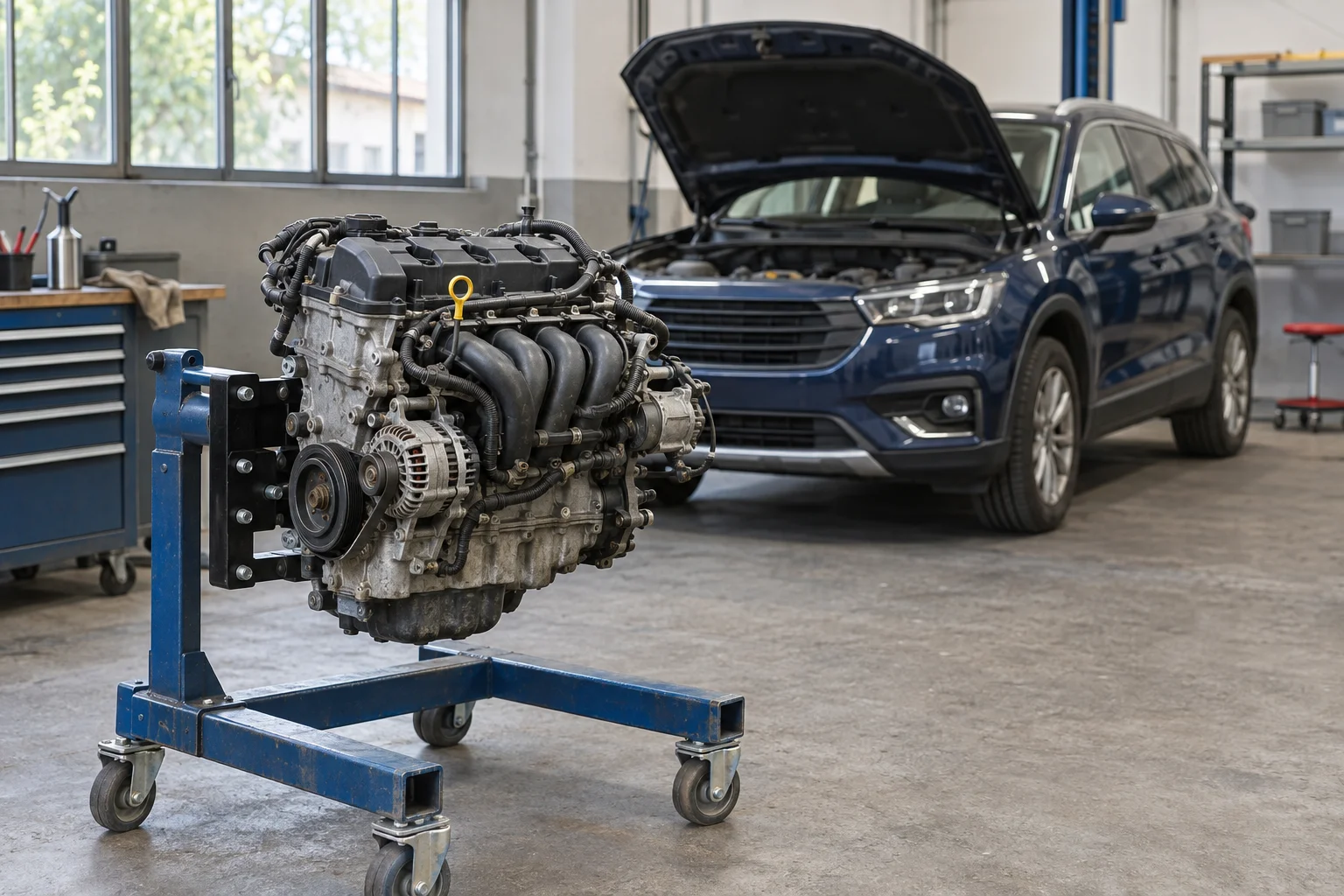
The engine has failed, and the workshop promises a replacement within three weeks. In the end, it takes three months, the bill has been paid, and a warning appears again just a few kilometres after collection. If this happens to you, you may wonder whether you have to accept it. The answer depends on three questions: what was agreed, what was actually installed, and whether the new fault is connected with the repair.

A case concerning a Mazda CX-5 handled by my firm followed precisely this pattern. It illustrates customers’ rights in the event of delay and defects, and the documents that can make the difference. The dispute ended in a settlement; no court determined the technical causes.

Key points

  • A “replacement engine” does not mean that all ancillary components are new. The order should specify in writing what will be supplied and what will be transferred from the old engine.
  • Record the maximum price and completion date in writing. If the repair is delayed, respond in writing and set a reasonable additional deadline.
  • A fault code is an indication, not proof of a defective repair. Have the fault memory read and keep the printout before codes are cleared or parts replaced.
  • First notify the workshop of defects in writing and request rectification. A price reduction or termination of the contract generally becomes available only if rectification is refused or not carried out in time.
  • Check your legal expenses insurance. Disputes with workshops are often covered under vehicle contractual legal expenses cover.

The case: three weeks promised, three months waited

After an engine failure, my client instructed a workshop to install a replacement engine. A maximum price of EUR 8,000 and a maximum repair period of three weeks were agreed; he paid EUR 4,500 in advance. An invoice described removal of the defective engine, supply and installation of a replacement engine, as well as seals, fluids, filters, a function check and a test drive. My client paid EUR 8,000 in total.

The vehicle was not ready until around three months later. According to my client, a warning appeared again just a few kilometres after collection. He also doubted whether a different engine had been installed at all. The workshop disputed this: it said that it had installed a replacement engine, transferred existing ancillary components and additionally replaced the turbocharger. What exactly was owed and what had actually been done remained disputed throughout.

The workshop is late: what you can do

In the Mazda case, the lengthy delay was also disputed. The workshop relied on a delay in engine delivery for which it was not responsible and on my client’s agreement to the postponement. Such disputes often arise when changes to dates are discussed only by telephone or in chat messages. Even a brief “OK, thanks” in response to news that the engine is delayed may later be interpreted as agreement to a new deadline.

If the workshop is in default, section 918 of the Austrian Civil Code (ABGB) allows the customer either to continue to insist on completion or to withdraw from the contract while granting a reasonable additional period for performance. An additional deadline can also be set orally, but is then difficult to prove. Set it in writing and make clear what will happen when it expires.

Has your car been in the workshop longer than agreed? I can assess whether and how you should set an additional deadline before you agree to a new date.

Replacement engine, base engine or reconditioning: what was ordered?

These terms are often confused. A “replacement engine” replaces the existing engine with a different unit; the term does not establish whether that unit is new, used or reconditioned. Engine reconditioning, by contrast, involves repairing the existing engine. Which parts are worked on or replaced depends on the order and the damage.

The German terms “Rumpfmotor” and “Grundmotor” describe the scope of an engine assembly, but are not used consistently in quotations. Ask whether, for example, the cylinder head is included and which ancillary components will be supplied new. The word “replacement engine” does not automatically promise a new turbocharger, injection components, alternator or vacuum pump. In the Mazda case, too, the workshop said it had installed a base engine assembly and transferred existing parts.

A replacement engine can therefore be installed using existing ancillary components. Whether that complies with the contract and constitutes technically proper work in a particular case depends on the agreed scope and the condition of the reused parts. “Reconditioned” also needs further explanation: which components were inspected, worked on and replaced?

What the invoices show – and what remains unresolved

In the Mazda case, an initial invoice described the supply and installation of a replacement engine. The final invoice additionally listed, among other things, a turbocharger, seals, oil, filters, a pressure sensor and labour. A vacuum pump was not listed as a separate item.

This does not establish that no different engine was installed. Conversely, the invoice does not prove which unit is actually in the vehicle. Delivery notes and supplier invoices, the engine number and traceable identification of parts can help establish this. Photographs taken during installation show the process but generally do not replace that evidence.

A fault after repair: what a fault code proves and what it does not

A subsequent ÖAMTC diagnostic printout showed fault code P258B, described as “Unterdruckpumpen-Steuerung, Außer Sollbereich” (vacuum pump control, outside the expected range). In simple terms, the engine control unit reports that a value relating to the vacuum pump is outside the expected range. The code does not say why. The printout contains neither a mechanical inspection of the pump nor an explanation of the deviation.

In many diesel vehicles, a vacuum pump supplies vacuum for functions including brake assistance. Examination of the vacuum system may therefore also involve lines, connections and non-return valves. The appropriate procedure for the particular vehicle depends on its configuration and the manufacturer’s specifications. The code alone establishes neither a specific pump defect nor an actual brake failure.

The fact that the warning appeared shortly after collection is good reason for a targeted investigation, but is not yet proof of a repair error. Conversely, the workshop’s reference to an “old ancillary component” does not by itself exclude every connection with the work. Even an old component must be properly connected and supplied when transferred to another engine.

A second workshop and a new quotation: not every item counts

In the Mazda case, my client later obtained a quotation from another workshop. In addition to a vacuum pump and fault diagnosis, it included differential work and wheel alignment, a new battery and the Austrian periodic vehicle inspection (Pickerl). The quoted work was not carried out.

As a customer, you can claim from the first workshop only costs connected with a defect in its work. For each item, it must therefore be clear which symptom it is intended to remedy and what finding justifies it. Maintenance and unrelated wear are not included. A quotation also does not establish which work is actually necessary.

Statutory warranty: your rights and time limits

For defective repair work, section 1167 ABGB refers to the general statutory warranty rules. Under section 922 ABGB, the agreed characteristics and those normally expected are particularly relevant. The specific order is therefore the starting point; the brief description “engine replacement” does not answer every detailed question.

Remedies also follow a sequence: section 932 ABGB generally provides for rectification or replacement first. A price reduction or termination of the contract becomes available subject to further conditions, for example where a remedy is refused or not provided in time. Termination also requires a defect that is more than minor. Which claims are viable depends on the agreement, the defect that can be proved and what has happened so far.

Repairs are generally subject to the ABGB time limits: the workshop is liable for defects present at handover that become apparent within two years; claims become time-barred three months after the end of that period (section 933 ABGB). If a defect appears within six months of handover, it is generally presumed to have been present at handover (section 924 ABGB). For reused old parts, the nature of the defect may prevent that presumption from applying, for example in the case of ordinary wear.

What to document before and after an engine replacement

  • Price and deadline: the maximum price, advance payment and completion date, all in writing.
  • Scope of work: the condition and origin of the replacement engine, included assemblies, reused ancillary components and agreed checks.
  • Performance: invoices, parts lists, delivery documents, photographs, the engine number and, if possible, the removed old parts.
  • Delays: workshop messages postponing completion, your replies and additional deadlines set in writing.
  • New complaints: date, mileage, the exact warning and complete diagnostic reports, preferably before the fault memory is cleared.
  • The workshop’s response: your written defect notification, any inspection or rectification offered, and subsequent correspondence.

If another workshop is to remove or replace parts, arrangements for preserving evidence should be clarified beforehand. Removed parts, measurements and photographs may later be decisive.

Frequently asked questions

How long may a workshop take to replace an engine?

As long as agreed. If no deadline was agreed, a reasonable period applies, depending on the scope of work and the usual delivery time for parts. If the deadline is exceeded, you can withdraw from the contract while setting a reasonable additional deadline.

What should I do if the fault returns after repair?

Have the fault memory read and retain the printout. Then notify the workshop of the defect in writing and request rectification. If the workshop refuses or asks for additional payment, a price reduction or termination of the contract may be available.

Who pays for a vehicle expert?

In court proceedings, the party requesting the evidence generally advances the costs. Ultimately, the losing party generally bears the costs, with proportionate allocation in cases of partial success. Legal expenses insurance generally also covers these costs within the scope of cover.

Help with a workshop dispute

My training as a vehicle mechanic enables me to understand invoices, workshop reports and diagnostic printouts from a technical perspective as well. This helps distinguish whether a document describes only an agreed service, a measured deviation or an already substantiated cause of damage, and which questions an expert needs to answer.

Send me the order, invoices, diagnostic printouts and your correspondence with the workshop, including chat messages if relevant. I will explain your legal position and sensible next steps. If you have legal expenses insurance, I will clarify cover for you. I represent clients in Vienna and throughout Austria in cooperation with my partner lawyers.

Contact: office@maydell-law.at · +43 1 2954251

Categories: Vehicle law

Tags: Defect, Repair

Used car worth less after repair: buyer entitled to a refund

The Austrian Supreme Court ruled in case 6 Ob 240/19s that a car buyer is entitled to money back if the repaired car is worth less than an equivalent defect-free vehicle. This also applies to used cars and concerns the vehicle's commercial diminution in value.

Mag. Patrick Maydell, LL.M., vehicle lawyer and trained motor mechanic, explains the main points.

1) Buyer discovers a leaking windscreen in a three-year-old car

The buyer purchased a three-year-old car from a dealer for EUR 33,500. During the test drive, he heard sloshing but assumed it was diesel in the tank. In fact, water had collected inside because the windscreen leaked. A small gap had remained in the seal between the glass and body when installed at the factory: a manufacturing defect. The water caused an oxidation layer on some electronic components. The buyer took the car to the dealer's specialist workshop for repair under the guarantee.

2) Even a used car must keep water out

The contract described the mechanical condition as class 2, good, with minor wear, no repairs needed, and minor adjustment or inspection required. Electrical and electronic equipment was also class 2, good, with the propulsion battery within its guarantee period and convenience electronics functional.

The Supreme Court held that a vehicle must have the characteristics ordinarily expected in trade, including roadworthiness and operational safety. This includes keeping moisture out, even for a used car.

3) After repair, the buyer seeks a refund

The buyer sued to return the car and recover the price through rescission (Wandlung). He argued that the water damage had not been properly repaired because wiring harnesses had merely been dried rather than cleaned, checked and replaced. He said the workshop had warned that the oxidation would cause future problems, that repairing the electronic defects was barely economical, and that the car was unsafe. He therefore claimed an irremediable defect and unsuccessful repair entitled him to rescission.

The dealer disputed this, saying it had properly repaired the car by replacing the windscreen and drying the vehicle.

Free initial assessment — call now

Call +43 1 2954251 or email office@maydell-law.at.

4) Supreme Court: the car was defective

The Court found that the vehicle was defective at delivery because the windscreen was not sealed to the body, causing water ingress and starting oxidation. A progressive oxidation process is a defect even before it reaches a stage capable of causing component failures.

The process was at least latent when risk passed to the buyer, so the buyer was entitled to repair.

5) The remaining oxidation was a minor defect: no right to return the car

The repair sealed the windscreen, dried the car and stopped the oxidation process. The court found that all components worked and no further oxidation was expected.

An oxidation layer on individual electronic components that neither impairs function nor continues to spread is a minor defect. The limited seriousness of these effects, without loss of function, had to be weighed against the impact of cancellation on the dealer. Rescission was therefore unavailable on this ground.

6) But the repair reduced the car's value, entitling the buyer to a partial refund

Although the repair was proper and stopped water ingress and functional problems, the car was worth less afterwards. This commercial diminution in value arose because it now had a value-reducing repair history that the parties had not agreed to.

In such circumstances, a buyer may be entitled to rescission or a price reduction, depending on whether the defect is serious or minor. Here, the loss in value was not sufficiently high relative to the purchase price to make it more than minor. Assessed in the context of this transaction, the remaining defect in the form of lost value was minor.

The buyer therefore could not return the car for a full refund, but could recover part of the price through a price reduction.

7) What the decision means

If a repaired vehicle is worth less than the equivalent vehicle without defects, the buyer may be entitled either to rescission, returning the vehicle for a full refund, or a price reduction. The extent of the loss in value is decisive. This applies to used vehicles too.

Mag. Maydell will discuss your legal options in a personal consultation. He works with vehicle experts to provide a quick, cost-effective assessment of the amount you may recover.

8) Problems with your vehicle?

Whether a seller concealed defects, you are a seller facing a buyer's complaints, or a repair has gone wrong, contact Mag. Patrick Maydell for a free initial assessment at +43 1 2954251 or office@maydell-law.at.

He specialises in vehicle law in Vienna and the surrounding area and is also a trained motor mechanic. His legal and technical knowledge assists particularly where:

  • a purchased vehicle has technical defects concealed by the seller;
  • a seller faces allegations of defects from the buyer;
  • a workshop refuses repairs under a guarantee or statutory warranty;
  • you were injured in a road accident and seek damages and compensation for pain and suffering;
  • an insurer refuses to pay after an accident;
  • you have problems with a leased vehicle or leasing company;
  • other vehicle-related disputes arise.

Free initial assessment — call now

Call +43 1 2954251 or email office@maydell-law.at.

Mag. Patrick Maydell, LL.M.
Vehicle lawyer
Neustiftgasse 17/1/9
1070 Vienna
Telephone: +43 1 2954251
office@maydell-law.at

Image source: Quality Repair

Categories: Vehicle law

Tags: Lawyer, Car, Money back, Vehicles, Defect, Price reduction, Repair, Reversal of a purchase, Rescission