

Initial assessment

Maydell Law · Lawyer in Vienna

Blog posts

Category Archives: Inheritance law

Inheritance actions: 12 tips from a lawyer
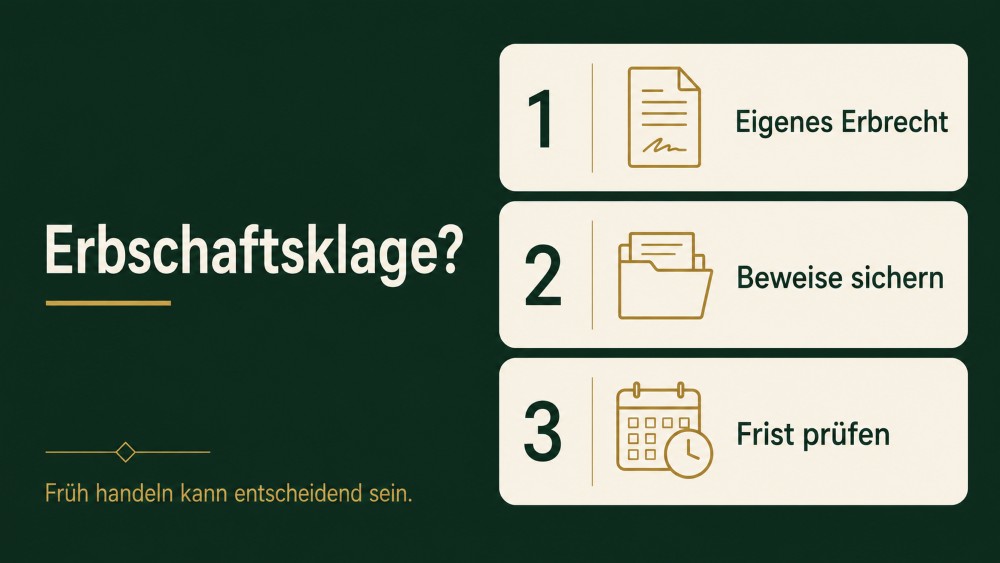
What you can do if the wrong person has inherited after probate

A close relative has died, probate is complete and the court has awarded the inheritance. Later, another will appears, doubts arise about the validity of a will, or someone who should have inherited under an earlier will has been overlooked.

An inheritance action (Erbschaftsklage) may help. It seeks transfer of all or part of the inheritance to the person with the better entitlement. The law uses terms such as Einantwortung, the formal transfer of the estate, and Abtretung der Erbschaft, its surrender to the rightful heir. Put simply: who is the correct heir?

This is not a routine lawsuit. It often concerns old documents, family conflicts, medical records and conversations from years earlier, alongside deadlines and significant cost risks. It is important to identify early what can legally be achieved and what evidence exists.

If something seems wrong with an inheritance, seek advice promptly. Experienced inheritance lawyer Mag. Patrick Maydell, LL.M. offers a free initial telephone assessment to clarify whether an inheritance action is appropriate, which documents are missing and whether a deadline requires urgent action.

1. What is an inheritance action?

It is a claim against the person to whom the court has already awarded the estate. The claimant must assert a better or at least equally strong inheritance right. The action may concern the entire estate or a share.

Einantwortung means that the probate court has determined the heir and legally transferred the estate to that person. Once that decision is final, a later claim to inheritance is generally pursued through an inheritance action.

The action concerns the inheritance as a whole or the claimed share. It is therefore generally unnecessary to list every asset in the claim. The estate includes liabilities as well as assets.

2. Before or after probate is complete?

Timing is decisive. While probate continues, competing inheritance rights are generally determined within those proceedings, where the court examines the rights asserted and the evidence.

Once the estate has been finally awarded, a later asserted better right generally requires a civil inheritance action.

Practical tip: do not delay objections even while probate is ongoing; claims can still become time-barred. Submit wills, messages and other important documents as early as possible.

3. When may an inheritance action be appropriate?

Typical situations include:

  • a will discovered only after probate;
  • several wills with uncertainty about which applies;
  • serious doubts about the deceased's understanding when making the will;
  • a will not written entirely by the testator potentially failing formal requirements;
  • a will that may have been forged, substituted, destroyed or deliberately suppressed;
  • a person potentially unworthy to inherit because they intentionally frustrated the true last wishes.

Not every inheritance dispute is an inheritance action. A person seeking only a compulsory share pursues a monetary claim rather than heir status. A claim to a single asset may also require another action. Choosing the wrong remedy can waste time and money.

4. What must the claimant prove?

It is not enough to attack the opponent's entitlement: the claimant must prove their own inheritance right.

For example, proving that the will favouring the appointed heir is invalid does not automatically win the case. The claimant must also show why they should inherit, perhaps under an earlier valid will or intestate succession.

The Supreme Court is clear: the claimant must establish a better or equivalent right of their own. Merely showing that the defendant should not inherit is insufficient. Before suing, examine both the weaknesses in the other party's right and the basis of your own.

5. What can the action achieve?

If successful, the defendant must surrender the inheritance or relevant share to the rightful heir. This is more than a statement on paper: the judgment corrects the earlier allocation of the estate.

The claim can cover the entire inheritance or a share even if every account, asset or debt is not yet known when proceedings begin. An estate's full extent often becomes clear only later.

Whether additional steps are required for property, accounts or assets already sold must be assessed individually.

6. When is a will invalid?

One common issue is testamentary capacity. The person must understand the meaning and consequences of their disposition and act accordingly: who will receive what after death and what that decision entails.

Doubts may arise with advanced dementia, serious confusion or impairment through illness or medication. A diagnosis alone does not decide the case. The person's actual condition at the precise time of making the will is decisive, making contemporary medical records and specific observations especially important.

Formal errors may also matter. A will not written entirely by the testator is subject to strict rules on signatures, a handwritten declaration and witnesses. Small details can be legally significant, so the original document should be examined.

7. What does unworthiness to inherit mean?

It broadly means being excluded from inheritance because of particularly serious misconduct. Statutory grounds include intentionally frustrating or attempting to frustrate the deceased's true last wishes.

This can involve forging, altering, destroying or suppressing a will, and may also include deliberately preventing proper application of intestate succession. Precise facts and intention are always crucial.

This is a serious allegation. Suspicion is insufficient; concrete documents, messages, witness evidence or unusual events surrounding the will are needed.

8. What deadline applies?

Inheritance claims generally have a three-year limitation period starting when the entitled person knows the facts supporting the claim, with an absolute maximum of thirty years from death.

The three years do not wait until every piece of evidence is secured or every legal issue resolved. Knowledge sufficient to bring a claim with a reasonable prospect of success is enough. When that point is reached depends strongly on the case.

Do not assume negotiations automatically stop time running. Their effect is legally delicate and can depend on how promptly proceedings follow failed talks. Calculate and record the deadline early.

9. Which evidence is particularly important?

Details often decide inheritance cases. Preserve:

  • all wills and other testamentary declarations;
  • the order transferring the estate and key probate documents;
  • medical records around the date of the will;
  • messages, emails and letters showing last wishes or possible influence;
  • names and contact details of people who personally observed the deceased's condition or statements;
  • documents about accounts, property, gifts and transactions already completed.

Medical expert evidence is often important for capacity disputes. The expert was not present when the will was made and relies on records and precise observations. General statements such as “he was very forgetful” are less useful than dated, concrete examples with context.

Practical tip: do not alter original documents, write on them or attach anything. Keep them safe and use copies or scans for everyday work.

10. What happens to the assets during proceedings?

After formal transfer, the recorded heir can generally dispose of inherited assets. Selling property or transferring money can create problems. The law protects good-faith purchasers from an apparent heir under certain conditions.

If a specific sale or transfer is threatened, urgently assess whether protective court measures are available and useful. They have their own requirements and are not automatic.

Delay can be risky. Inform me immediately of a planned sale, gift or substantial transfer.

11. What costs arise?

Costs primarily depend on the value of the disputed estate or share. They include court and legal fees and, depending on the issues, experts, witnesses or translations.

In Austrian civil litigation, a party that loses entirely generally reimburses the opponent's necessary costs. Partial success normally leads to proportionate allocation or offsetting. Recoverable costs follow statutory rules and do not necessarily match every arrangement with your own lawyer.

Before suing, discuss prospects, the amount in dispute, potential expert evidence and cost risks. An honest litigation assessment is part of the advice.

12. Which mistakes should you avoid?

The most common mistake is waiting too long, particularly as the starting point of the three-year period is often disputed.

Another is concentrating solely on weaknesses in the opponent's inheritance right without proving your own. Vague allegations such as “the will cannot be right” are also unhelpful. Courts need precise facts: what was wrong, when, who was present and which document or message supports it?

Finally, a successful claim does not automatically resolve every practical consequence. Accounts, property, assets already sold or foreign assets may require further steps.

What you can do now

Collect available key documents: the estate transfer order, wills, correspondence, medical records and a short chronology. Record when you learned each relevant fact, as that date can matter for limitation.

Then clarify:

  • Has probate finally concluded?
  • What is the basis of your own inheritance right?
  • Which facts challenge the other person's right?
  • What evidence exists and what still needs securing?
  • When might limitation have begun?
  • Is a sale or transfer of assets threatened?

Early assessment can prevent an expensive, hopeless case or show why urgent action is necessary.

Free assessment of an inheritance action

Do you doubt a will, were you overlooked in probate, or did you only later discover a possible inheritance right? I review your documents and evidence and discuss prospects, risks and next steps.

Arrange a free initial telephone conversation with Mag. Patrick Maydell, LL.M. I look forward to hearing from you.

Mag. Patrick Maydell, LL.M.
Attorney at Law
Neustiftgasse 17/1/9
1070 Vienna
Telephone: +43 1 2954251
office@maydell-law.at

Categories: Inheritance law

Tags: Inheritance action, Will

Successive heirs: how to enforce your rights

Eight tips from Mag. Patrick Maydell, LL.M., Attorney at Law.

1. What are initial and subsequent heirs?

A testator can appoint an heir and also determine who receives the same assets after that heir's death. The initial heir (Vorerbe) must pass the assets originating from the testator to a subsequent heir (Nacherbe) at a specified time, such as the initial heir's death. This Austrian arrangement is called fideicommissary substitution.

This does not mean appointing the initial heir's own heir. The subsequent heir receives only the original testator's assets, not the initial heir's separate property.

The law limits the number of successive heirs to prevent assets being tied up over generations. Any number may be appointed if they are already alive when the will is made. For persons not yet alive, meaning neither conceived nor born, the testator may appoint one subsequent heir for real estate and at most two for other assets such as money.

The arrangement may cover the whole estate or only part. For example, a wife may inherit a holiday apartment, with the children to receive it after her death.

2. Rights of the initial heir

The initial heir's position resembles that of a usufructuary. Although they become owner on formal transfer of the estate and may use the asset fully, they must preserve its substance and may neither sell nor encumber it. They may dispose of it only insofar as the subsequent heir's rights are not infringed. Sale is possible where necessary to avoid damage to the asset.

The initial heir may enter into longer-term leases. Acting together, the initial and subsequent heirs may dispose of the asset without restriction, including selling or encumbering it, and may terminate the substitution arrangement.

Free initial assessment — call now

Call +43 1 2954251 or email office@maydell-law.at.

3. Rights and protection of the subsequent heir

The subsequent heir becomes owner only when the initial inheritance ends. The timing primarily depends on the testator's wishes. Nevertheless, the subsequent heir already has protective rights against the initial heir, including a preventive injunction if the assets are intentionally damaged, for example deliberately damaging a house to reduce its value.

An inventory must be drawn up ex officio to safeguard the assets. For real estate, the substitution is also noted in the land register as a Substitutionsband.

4. Who pays the expenses?

Expenses relating to property or other assets are allocated according to their nature: those normally borne by a usufructuary fall on the initial heir, while those borne by an owner fall on the subsequent heir.

5. Do the initial heir's restrictions bind third parties?

If the initial heir breaches the automatic prohibition on sale or encumbrance, for example selling without the subsequent heir's consent, or otherwise infringes that heir's rights, the prevailing view is that the disposition is invalid against third parties too.

6. Can creditors reach the property?

Creditors of the original deceased or estate may proceed against the estate without restriction. The existence of a subsequent inheritance cannot be raised against them.

The initial heir's own creditors cannot seize the substitution assets because that heir's position is comparable to a usufructuary's. They may, however, reach rental income, for example by seeking compulsory administration of the property.

7. Substitution of the remainder

Unlike ordinary fideicommissary substitution, substitution of the remainder allows the initial heir unrestricted lifetime disposal. They must pass on only what remains at death or when the substitution event occurs. They cannot dispose of that remaining part by a disposition effective on death, such as a will or codicil.

To prevent assets remaining for the subsequent heir, the initial heir could consume them or transfer them to a third party during life. However, abuse of rights is prohibited. If disposal is solely intended to harm the subsequent heir, that heir may claim damages and seek an injunction.

8. What is an alternative heir?

A subsequent heir should not be confused with an alternative or substitute heir (Ersatzerbe). The latter inherits only if the appointed heir never becomes heir, for example because they die before the testator or decline the inheritance.

Example: “My son Hans is to inherit only if my daughter Anna dies before me.”

Free initial assessment — call now

If you have questions or need help with inheritance law, call for a free initial telephone assessment or email office@maydell-law.at.

Mag. Patrick Maydell, LL.M.
Attorney at Law
Neustiftgasse 17/1/9
1070 Vienna
Telephone: +43 1 2954251
office@maydell-law.at

Categories: Inheritance law

Tags: Inheritance law, Successive heirs, Subsequent inheritance, Substitution, Initial inheritance

Compulsory shares: 12 tips from a lawyer

Learn the essentials of the statutory compulsory share: how to obtain yours, the legal remedies available and how heirs can defend unjustified claims. Experienced inheritance lawyer Mag. Patrick Maydell, LL.M. offers these practical tips.

1. What is a compulsory share?

A person can generally choose whom to benefit on death. Compulsory-share law limits that freedom: certain persons must receive a specified part of the estate through a testamentary disposition, such as a will. If they do not, those entitled have a monetary claim against the estate or the heirs.

The compulsory share must be freely available to its recipient, without conditions, encumbrances, time limits or obligations restricting it.

2. Who is entitled?

The deceased's descendants, meaning children, and spouse or registered partner are entitled to a compulsory share. Siblings and parents are not.

3. How much is the compulsory share and how is it calculated?

It is half the statutory inheritance share. Under intestate succession, a spouse alongside children receives one third and the children together two thirds. The spouse's compulsory share is therefore one sixth and the children's combined share one third. If there is no spouse, children share equally: with three children, each statutory share is one third and each compulsory share one sixth.

The calculation uses the net estate: assets less liabilities. Liabilities include the deceased's debts and costs arising from death, the funeral and probate proceedings. Legacies do not reduce the net estate for this purpose.

4. When must you claim?

The claim arises at death but can only be demanded one year afterwards. It becomes time-barred three years after knowledge of the facts establishing the claim, described here as three years after learning of the death.

5. Who owes the compulsory share?

Before the estate is formally transferred to the heirs by the probate court (Einantwortung), the estate owes it; afterwards, the heirs do. If the deceased did not provide the entitlement in full, for example through lifetime gifts, a monetary claim arises. Legatees must then contribute proportionately alongside the heirs, up to the value of the estate.

Free initial assessment — call now

Call +43 1 295 4251 for a free initial assessment by telephone or email office@maydell-law.at.

6. How are gifts added to and credited against the compulsory share?

6a. Gifts to persons entitled to a compulsory share

If the deceased reduced their assets through lifetime gifts to such persons, for example children, the other entitled persons and the heirs may demand that these gifts be added and credited. The gift's value is first added to the estate, and compulsory shares are calculated on the increased amount. The recipient must then credit the gift against their own compulsory share and receives correspondingly less. Gifts to persons entitled to a compulsory share are included without a time limit.

Example: assets of EUR 110,000 less debts of EUR 30,000 leave a net estate of EUR 80,000. There are two children, each entitled to half under intestate succession and a compulsory share of one quarter. The first child received a car worth EUR 20,000 during the deceased's lifetime. The second child may demand inclusion of that gift. The calculation basis becomes EUR 100,000 and each compulsory share EUR 25,000. After crediting the EUR 20,000 car, the first child receives EUR 5,000.

6b. Gifts to persons not entitled to a compulsory share

At an entitled person's request, gifts to persons outside the compulsory-share group are also added when calculating the shares. However, this applies only to gifts made within two years before death.

Example: the net estate is EUR 80,000. A year before death, the deceased gave a friend EUR 10,000. The two children, with no surviving spouse, can request its inclusion. The calculation basis becomes EUR 90,000, giving each child one quarter, or EUR 22,500.

6c. Exceptions

The following gifts are exempt from inclusion and do not generate an additional compulsory-share payment:

  • gifts fulfilling a moral duty, such as a ring for a spouse's silver wedding anniversary;
  • gifts for charitable purposes, such as a donation to a kindergarten;
  • gifts that did not reduce the donor's capital, made from current income and savings from the preceding year.

7. How can you enforce your compulsory share?

If you believe you have received too little, you can bring an action for supplementation of the compulsory share against the heirs or estate. In practice, I recommend first calculating the entitlement correctly and sending a written demand. If an out-of-court agreement cannot be reached, proceedings must be brought.

8. Can a compulsory share be taken away?

Deprivation of the compulsory share through disinheritance requires a statutory ground. These include the entitled person:

  • committing an offence against the deceased or close relatives, such as a spouse or sibling, which can only be committed intentionally and carries more than one year's imprisonment, for example aggravated bodily harm or serious fraud;
  • intentionally preventing or attempting to prevent fulfilment of the deceased's true last wishes, for example by forging a will;
  • reprehensibly causing the deceased serious emotional suffering;
  • otherwise grossly neglecting family-law duties towards the deceased;
  • being sentenced to life imprisonment or twenty years' imprisonment for an intentional offence.

The deceased must have ordered disinheritance expressly or implicitly by omitting the person from the testamentary disposition.

9. Can the compulsory share be reduced by half?

A reduction by half is possible if there was no close family relationship for at least twenty years. The individual circumstances matter; for example, there may be no close relationship if the deceased saw the person only three times in their life. The reduction must be ordered in a testamentary disposition, expressly or implicitly through omission.

Reduction is excluded if the deceased avoided contact without reason or gave justified cause for the lack of contact, for example where a father refused contact with his daughter without her having given him a reason. Here too, personal circumstances are decisive.

10. Waiving a compulsory share or inheritance

A person entitled to a compulsory share may waive it during the deceased's lifetime or in probate proceedings. This often happens when assets are distributed in advance, for example where a child receives a property or apartment in return for a waiver.

The testator may then dispose of assets without that compulsory-share restriction. Unless otherwise agreed, the waiver also applies to the waiving person's descendants. A waiver may prevent disputes or preserve a business intended for one child, where other compulsory-share claims could threaten its continued existence.

A compulsory-share waiver does not remove the person's statutory inheritance right. If there is no testamentary disposition and intestate succession applies, the person may still receive part of the estate.

A waiver of inheritance, by contrast, includes both the compulsory share and statutory inheritance rights. Even then, the testator may still benefit the person in a will, for example by leaving something to a child who waived inheritance rights.

11. Deferral and instalments

The deceased may order deferral or payment by instalments for up to five years in a testamentary disposition. An heir owing the share may also request deferral or instalments for up to five years if immediate payment would cause excessive hardship, for example requiring sale of the home needed to meet an urgent housing need because other assets are insufficient. In particularly deserving cases, deferral may extend to a maximum of ten years.

12. What does litigation cost, and will legal expenses insurance cover it?

Costs depend on the amount in dispute, meaning the compulsory share claimed. Higher claims mean higher litigation costs, consisting of lawyers' fees and court fees. The examples in this article are EUR 1,048.44 for bringing a EUR 17,000 claim plus EUR 743 court fees, and EUR 1,992.36 for a EUR 50,000 claim plus EUR 1,459 court fees. Court fees are payable once, regardless of the duration of proceedings.

If you win, you are entitled to reimbursement of litigation costs by the opponent, including the costs you advanced.

If you have legal expenses insurance, check whether inheritance law is included. If so, it covers the litigation costs under the policy. I can make a free written coverage enquiry to establish whether your particular case is covered.

If you are not yet insured, note that policies often contain waiting periods. Depending on their terms, cover may be refused, for example, if the death occurs one year after the policy was taken out. It is therefore important to arrange cover in good time.

How I can help

As a specialist inheritance lawyer, I advise and represent you in all matters involving inheritance and compulsory shares, including:

  • enforcing inheritance rights and defending unjustified claims in contested estates in and out of court;
  • estate planning, including purchase and gift agreements, gifts effective on death and waivers of inheritance or compulsory shares;
  • drafting, registering and holding your will in safekeeping;
  • advice and representation in inheritance partition proceedings — see my article on partition actions;
  • calculating your compulsory share and helping prevent inheritance disputes;
  • advice on succession and the effects of an acceptance declaration, and representation in probate proceedings.

Free initial assessment — call now

If you have questions or need help enforcing or defending compulsory-share claims, we offer a free initial telephone assessment. Call +43 1 295 4251 or email office@maydell-law.at.

Mag. Patrick Maydell, LL.M.
Attorney at Law
Neustiftgasse 17/1/9
1070 Vienna
Telephone: +43 1 295 4251
office@maydell-law.at

Categories: Inheritance law

Legacies: how to enforce your rights

Learn the essentials of legacies and bequests from experienced inheritance lawyer Mag. Patrick Maydell, LL.M.

1. What is a legacy?

A legacy or bequest (Vermächtnis or Legat) is a benefit left by the deceased to a legatee without making that person an heir. It does not confer a share in the entire estate, but a particular asset or benefit. Anything that benefits the legatee can be bequeathed: a physical object such as a car or painting, a claim such as a bank balance, a right of residence, a business and so on.

A legacy of a specific asset is effective only if the asset belongs to the deceased or the heir. This means the testator can even leave an asset belonging to the heir rather than to the testator. The heir can avoid this by declining the inheritance.

The testator may also oblige the heir to acquire an asset and transfer it to the legatee, known as a procurement legacy (Verschaffungsvermächtnis). If its owner will not sell, or will sell only above market value, this becomes a monetary legacy equal to market value.

If the asset is pledged or otherwise encumbered, the legatee must also take over the associated burdens. These include not only security rights and easements but also the deceased's personal debts connected with the asset, for example a loan taken out to buy it.

2. Who is entitled to a legacy?

The deceased must direct in a testamentary disposition, such as a will or codicil, that a particular person receive a particular asset. The beneficiary is usually a third party who is not an heir, but an heir can also receive a legacy. In that case, it must be established whether it is additional to the inheritance share or to be deducted from it.

3. Who owes the legacy?

Before the estate is formally transferred to the heir by the probate court (Einantwortung), the estate owes the legacy; afterwards, the heir does. The legatee has a claim against the estate or heir and becomes owner only when it is fulfilled, for example through delivery or registration in the land register.

Free initial assessment — call now

Call +43 1 295 4251 or email office@maydell-law.at for a free initial telephone assessment.

4. When does the entitlement arise?

Legacies fall due immediately on death. However, monetary legacies and legacies of assets outside the estate can only be demanded after one year from death, unless the testator ordered earlier payment.

5. What is the deadline for claiming?

The claim to delivery of the bequeathed asset becomes time-barred three years after knowledge of the facts establishing the entitlement.

6. How can a legacy be enforced?

A legatee may bring a separate action to enforce the claim, a legacy action (Vermächtnisklage). They may also request separation of the estate, meaning separation of the bequeathed asset from the estate's assets. If the legatee lacks full legal capacity and has not received the legacy, the heir must provide security before the estate is transferred.

7. Can a legacy be reduced?

A reduction is possible in two situations.

First: an heir making a conditional declaration of acceptance limits liability to the value of the assets received. They take on the deceased's debts only up to that amount and may proportionately reduce legacies that cannot be satisfied from the estate.

Example: the deceased leaves assets of EUR 100,000 and debts of EUR 60,000. Son B is the heir; C is to receive EUR 50,000 as a legacy. If B accepts conditionally, only EUR 40,000 is payable to C, being EUR 100,000 less EUR 60,000. If the heir accepts unconditionally, the full EUR 50,000 is payable.

Second: if a person entitled to a compulsory share, such as a child limited to that share, has not received the full entitlement from the deceased, a monetary claim arises. The heir need not fund it alone and may require the legatee to contribute. This reduction right applies whether the inheritance is accepted conditionally or unconditionally.

8. What is a care legacy?

For deaths after 31 December 2016, a person close to the deceased who provided care may receive appropriate compensation from the estate. The question whether the care has already been compensated by a benefit from the deceased or an agreed payment must be considered.

Care means activity that provides the necessary support and assistance as far as possible and improves the person's ability to lead a self-determined life according to their needs. The required level is an average of twenty hours per month for at least six months within the final three years of life.

If a care legacy is claimed, the notary acting as court commissioner in probate proceedings must seek agreement on its fulfilment. If no agreement is reached, the caregiver may sue.

9. What does litigation cost, and will insurance cover it?

The cost of the claim and proceedings depends on the amount in dispute, meaning the legacy claimed. The higher this amount, the higher the litigation costs. I will be pleased to provide an individual estimate.

If you win, you are entitled to reimbursement of litigation costs by the opponent, including costs advanced.

If you have legal expenses insurance, check whether inheritance law is included. Where it is, litigation costs are covered under the policy. I can make a free written coverage enquiry for your specific case.

If you do not yet have insurance, note that policies often contain waiting periods. Depending on the terms, an insurer may refuse cover, for example if the death occurs one year after the policy began. Arrange insurance in good time.

How I can help

As a specialist inheritance lawyer, I advise and represent you on inheritance and legacy matters, including:

  • enforcing inheritance rights and defending unjustified claims in contested estates in and out of court;
  • estate planning, including purchase and gift agreements, gifts effective on death and waivers of inheritance or compulsory-share rights;
  • drafting, registering and holding your will in safekeeping;
  • advice and representation in inheritance partition proceedings — see partition actions;
  • calculating compulsory shares and helping prevent disputes;
  • advice on succession and acceptance declarations, and representation in probate proceedings.

Free initial assessment — call now

If you have questions or need help claiming or defending a legacy, I offer a free initial telephone assessment. Call +43 1 295 4251 or email office@maydell-law.at.

Mag. Patrick Maydell, LL.M.
Attorney at Law
Neustiftgasse 17/1/9
1070 Vienna
Telephone: +43 1 295 4251
office@maydell-law.at

Categories: Inheritance law

Tags: Legacy, Legacy