

VW Sharan 2.0 TDI: defective sunroof – why describing the defect matters
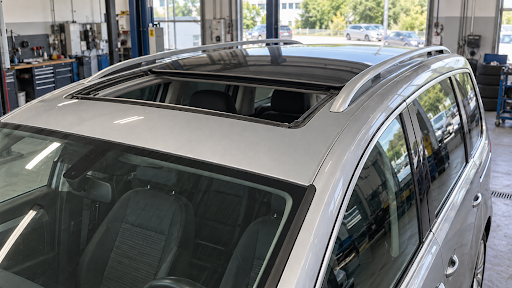
The electric glass roof of a VW Sharan 2.0 TDI reverses when closing and remains open. Yet the inspection report refers to the “roof blind control unit” – and the court proceedings turn on which defect that description covers. A case from my practice shows how a seemingly minor difference in terminology can become a decisive legal issue. The proceedings ended in a settlement covering repairs to the sunroof and auxiliary heater, together with a contribution towards the expert’s fees.
Roof blind or glass roof: a word with consequences
Our client had purchased a VW Sharan 2.0 TDI Highline of the 7N generation: a seven-seat diesel with 130 kW (177 PS), model year 2015, with an electric glass roof and an interior sunblind. The purchase price was EUR 20,500. According to his account, he noticed the roof fault just three or four days after buying the car. He pressed the switch and the glass roof moved all the way back. When he then tried to close it, it moved forwards but stopped just short of closing fully and moved back again.
The ÖAMTC inspection report recorded fault code “2907 roof blind control unit – malfunction”. The statement of claim adopted the description “fault in the roof blind control system”. It later became a point of dispute whether this also covered the reported problem with the glass roof’s closing function.
For the buyer, these were all aspects of the same roof problem. Technically, however, a distinction must be made: the interior sunblind shields the cabin from sunlight, while the movable glass roof sits above it. According to my client, when he later collected the vehicle after several weeks in the workshop, he and the dealer tested both functions. The blind opened and closed. It was then retracted again so that the glass roof was visible. During the test, the roof could be opened and closed once, but he perceived it as moving very stiffly and making an unusual noise. He recalls that, despite his enquiry, the dealer confirmed that the roof had been repaired. This account reflects the buyer’s perception.
What the court-appointed expert actually found
At the court-appointed inspection in a workshop, the Sharan’s odometer read 157,893 kilometres. The buyer, the parties’ legal representatives, a workshop technician and the court-appointed expert were present. The sunblind was tested first and worked properly. Tilting the glass roof and closing it from that position also worked. The fault appeared when the roof was slid fully open and then closed: the glass moved forwards to its stop, but its rear edge did not lower and it automatically reopened by approximately 20 centimetres. Several attempts produced the same result. The sunroof’s basic setting procedure could not be completed even with the manufacturer’s diagnostic equipment.
At that point, no fault relating to the sunroof or roof blind was stored in the fault memory. Nevertheless, the malfunction could be observed directly. On this particular vehicle, this demonstrated that a fault memory without relevant entries is no substitute for testing the function actually complained of.
Partial dismantling revealed signs of earlier repairs. The right-hand guide rail was photographed. The expert found material loss on the motor’s drive pinions and the moving rails. Swarf was clearly visible around these small drive gears. The glass roof could only be closed again after removing the motor and carrying out several adjustments. Full dismantling was initially avoided: my client wanted to continue using the Sharan, and with an open roof the vehicle would have been unusable in the rain. The roof was then closed and watertight again, but it was not to be opened until repaired.
The subsequent estimate for repairing the roof amounted to EUR 3,696.77 including VAT. It included work on cables and guides, removal of the headlining and two sunroof motors. This was an estimate prepared before full dismantling; it did not establish which parts would actually need replacing. If the roof frame also needed to be replaced, the expert’s report indicated an additional EUR 1,839.60 including VAT. Overall, the expert estimated the roof repair at approximately EUR 3,500 to EUR 5,500. Diagnosis of the heating problem revealed another specific distinction: the affected component was the auxiliary heater, not the air conditioning. Its repair was estimated at EUR 1,730.09 including VAT.
These findings alone did not, however, establish who had caused the mechanical damage or whether the earlier fault code reflected the same technical cause. Those questions must be distinguished from establishing the current defect.
The legal question: clarification or amendment of the claim?
During the proceedings, it was explained in greater detail that the complaint concerned the glass roof’s closing function. The opposing party objected that this introduced a different defect into the proceedings and also raised a limitation defence.
At the oral hearing, the judge stated that she considered the previous description sufficient and did not regard the clarification as an amendment of the claim.
The statutory starting point is section 235(4) of the Austrian Code of Civil Procedure (ZPO): factual allegations in a claim may be supplemented, explained or corrected without this constituting an amendment of the claim, provided that the basis of the claim remains unchanged. Whether that condition is met depends on the previous submissions and the particular additional explanation.
For car buyers, there is a practical lesson: describe what does not work on the vehicle as early and as clearly as possible. Technical terms and diagnostic codes are useful clues, but they should be considered alongside the observed symptoms. Merely changing the name of a fault does not automatically cover every defect subsequently identified.
The judge’s oral assessment was not a final determination by judgment. The proceedings ended in a settlement, so the disputed legal questions were not decided in a reasoned judgment.
The settlement: two repairs and a EUR 2,300 contribution to costs
In the settlement, the seller undertook to:
- Repair the auxiliary heater and remedy the sunroof defect, in each case in accordance with the findings in the expert’s report.
- Complete both repairs within four weeks of the buyer handing the vehicle over to the seller.
- Pay a contribution of EUR 2,300 towards the expert’s fees to the claimant’s lawyer within 14 days.
The settlement also provides for a final resolution of all mutual claims and demands between the parties. The contribution to costs is an agreed partial reimbursement of the expert’s fees.
What to document if you encounter a similar vehicle defect
- The specific behaviour: which function fails? What happens when you open, close or operate a switch? Does the problem occur constantly or only occasionally?
- The timing: record the date and mileage when the problem first occurs and on subsequent occasions.
- Photographs or short videos: record the fault where it is safe to do so. Avoid further operation if this could cause damage.
- Your notification to the seller: describe the problem in writing and keep the replies. Supplement any fault code with your own observations.
- The history of attempted repairs: keep work orders and invoices. Record which work was promised and whether the same fault persists after the vehicle is returned.
A sentence such as “The glass roof reverses when closing and remains open” makes the complaint immediately understandable to the seller, the workshop and the court. It is precisely this connection between the buyer’s observations, the technical documents and the legal claim that matters in vehicle disputes.
Free initial assessment
Is your sunroof sticking, is another vehicle function failing, or does the dealer say a defect has been repaired despite continuing problems? As a lawyer and trained motor mechanic, I assess your case from both a legal and a technical perspective.
Send me your purchase contract, any inspection reports and correspondence about repairs for a free initial telephone assessment. You can reach my firm on 01/295 4251 or office@maydell-law.at.
If you are considering returning your vehicle rather than having it repaired, you will find further information in the article “Cancelling a car purchase in Austria: returning a defective car”.
Categories: Vehicle law

Mag. Patrick Maydell, LL.M.
Lawyer in Vienna.
Property law, vehicle law and inheritance law.