

Months in the workshop, then the fault returns: your rights after an engine replacement
By Mag. Patrick Maydell, LL.M. – lawyer in Vienna and trained vehicle mechanic
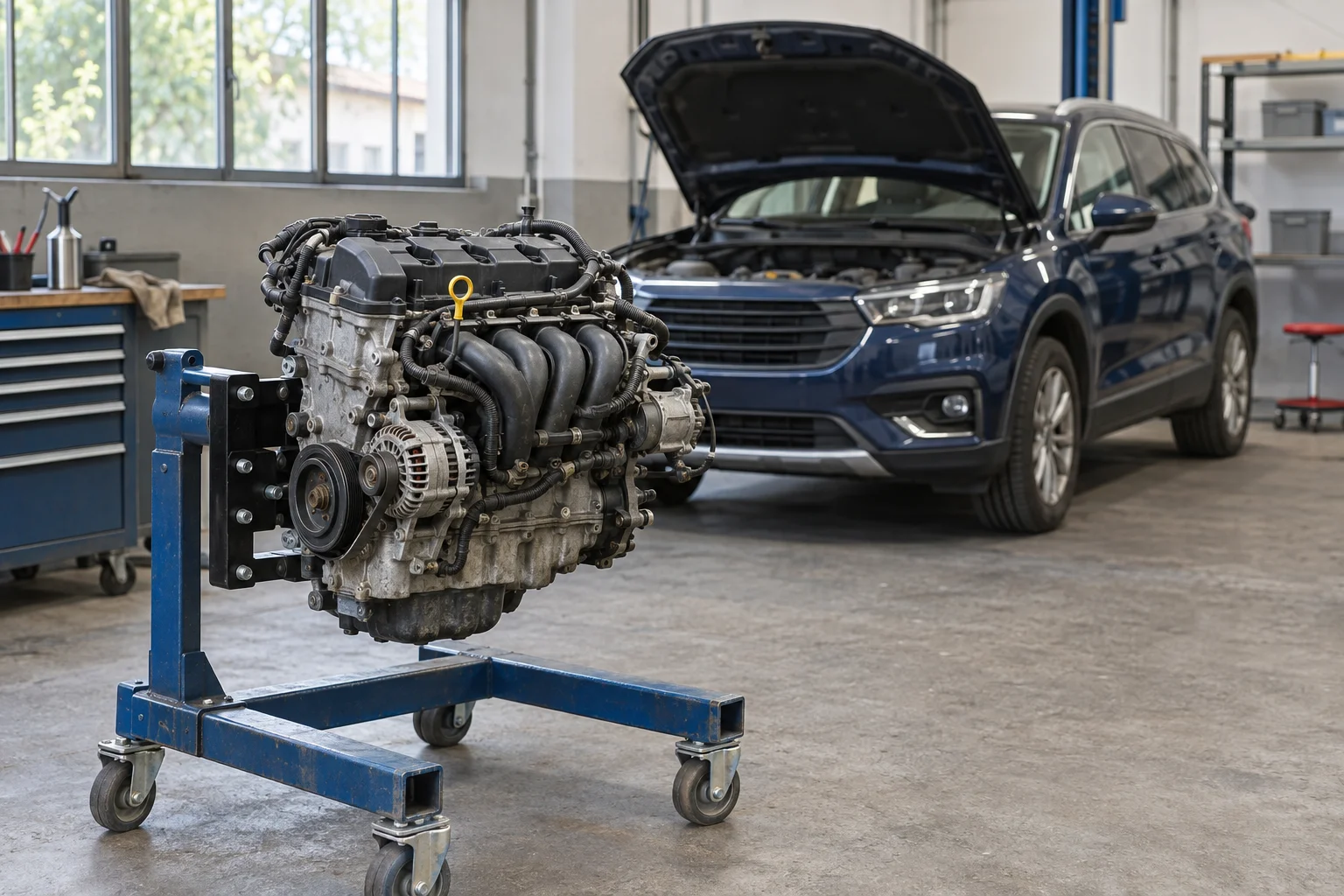
The engine has failed, and the workshop promises a replacement within three weeks. In the end, it takes three months, the bill has been paid, and a warning appears again just a few kilometres after collection. If this happens to you, you may wonder whether you have to accept it. The answer depends on three questions: what was agreed, what was actually installed, and whether the new fault is connected with the repair.
A case concerning a Mazda CX-5 handled by my firm followed precisely this pattern. It illustrates customers’ rights in the event of delay and defects, and the documents that can make the difference. The dispute ended in a settlement; no court determined the technical causes.
Key points
- A “replacement engine” does not mean that all ancillary components are new. The order should specify in writing what will be supplied and what will be transferred from the old engine.
- Record the maximum price and completion date in writing. If the repair is delayed, respond in writing and set a reasonable additional deadline.
- A fault code is an indication, not proof of a defective repair. Have the fault memory read and keep the printout before codes are cleared or parts replaced.
- First notify the workshop of defects in writing and request rectification. A price reduction or termination of the contract generally becomes available only if rectification is refused or not carried out in time.
- Check your legal expenses insurance. Disputes with workshops are often covered under vehicle contractual legal expenses cover.
The case: three weeks promised, three months waited
After an engine failure, my client instructed a workshop to install a replacement engine. A maximum price of EUR 8,000 and a maximum repair period of three weeks were agreed; he paid EUR 4,500 in advance. An invoice described removal of the defective engine, supply and installation of a replacement engine, as well as seals, fluids, filters, a function check and a test drive. My client paid EUR 8,000 in total.
The vehicle was not ready until around three months later. According to my client, a warning appeared again just a few kilometres after collection. He also doubted whether a different engine had been installed at all. The workshop disputed this: it said that it had installed a replacement engine, transferred existing ancillary components and additionally replaced the turbocharger. What exactly was owed and what had actually been done remained disputed throughout.
The workshop is late: what you can do
In the Mazda case, the lengthy delay was also disputed. The workshop relied on a delay in engine delivery for which it was not responsible and on my client’s agreement to the postponement. Such disputes often arise when changes to dates are discussed only by telephone or in chat messages. Even a brief “OK, thanks” in response to news that the engine is delayed may later be interpreted as agreement to a new deadline.
If the workshop is in default, section 918 of the Austrian Civil Code (ABGB) allows the customer either to continue to insist on completion or to withdraw from the contract while granting a reasonable additional period for performance. An additional deadline can also be set orally, but is then difficult to prove. Set it in writing and make clear what will happen when it expires.
Has your car been in the workshop longer than agreed? I can assess whether and how you should set an additional deadline before you agree to a new date.
Replacement engine, base engine or reconditioning: what was ordered?
These terms are often confused. A “replacement engine” replaces the existing engine with a different unit; the term does not establish whether that unit is new, used or reconditioned. Engine reconditioning, by contrast, involves repairing the existing engine. Which parts are worked on or replaced depends on the order and the damage.
The German terms “Rumpfmotor” and “Grundmotor” describe the scope of an engine assembly, but are not used consistently in quotations. Ask whether, for example, the cylinder head is included and which ancillary components will be supplied new. The word “replacement engine” does not automatically promise a new turbocharger, injection components, alternator or vacuum pump. In the Mazda case, too, the workshop said it had installed a base engine assembly and transferred existing parts.
A replacement engine can therefore be installed using existing ancillary components. Whether that complies with the contract and constitutes technically proper work in a particular case depends on the agreed scope and the condition of the reused parts. “Reconditioned” also needs further explanation: which components were inspected, worked on and replaced?
What the invoices show – and what remains unresolved
In the Mazda case, an initial invoice described the supply and installation of a replacement engine. The final invoice additionally listed, among other things, a turbocharger, seals, oil, filters, a pressure sensor and labour. A vacuum pump was not listed as a separate item.
This does not establish that no different engine was installed. Conversely, the invoice does not prove which unit is actually in the vehicle. Delivery notes and supplier invoices, the engine number and traceable identification of parts can help establish this. Photographs taken during installation show the process but generally do not replace that evidence.
A fault after repair: what a fault code proves and what it does not
A subsequent ÖAMTC diagnostic printout showed fault code P258B, described as “Unterdruckpumpen-Steuerung, Außer Sollbereich” (vacuum pump control, outside the expected range). In simple terms, the engine control unit reports that a value relating to the vacuum pump is outside the expected range. The code does not say why. The printout contains neither a mechanical inspection of the pump nor an explanation of the deviation.
In many diesel vehicles, a vacuum pump supplies vacuum for functions including brake assistance. Examination of the vacuum system may therefore also involve lines, connections and non-return valves. The appropriate procedure for the particular vehicle depends on its configuration and the manufacturer’s specifications. The code alone establishes neither a specific pump defect nor an actual brake failure.
The fact that the warning appeared shortly after collection is good reason for a targeted investigation, but is not yet proof of a repair error. Conversely, the workshop’s reference to an “old ancillary component” does not by itself exclude every connection with the work. Even an old component must be properly connected and supplied when transferred to another engine.
A second workshop and a new quotation: not every item counts
In the Mazda case, my client later obtained a quotation from another workshop. In addition to a vacuum pump and fault diagnosis, it included differential work and wheel alignment, a new battery and the Austrian periodic vehicle inspection (Pickerl). The quoted work was not carried out.
As a customer, you can claim from the first workshop only costs connected with a defect in its work. For each item, it must therefore be clear which symptom it is intended to remedy and what finding justifies it. Maintenance and unrelated wear are not included. A quotation also does not establish which work is actually necessary.
Statutory warranty: your rights and time limits
For defective repair work, section 1167 ABGB refers to the general statutory warranty rules. Under section 922 ABGB, the agreed characteristics and those normally expected are particularly relevant. The specific order is therefore the starting point; the brief description “engine replacement” does not answer every detailed question.
Remedies also follow a sequence: section 932 ABGB generally provides for rectification or replacement first. A price reduction or termination of the contract becomes available subject to further conditions, for example where a remedy is refused or not provided in time. Termination also requires a defect that is more than minor. Which claims are viable depends on the agreement, the defect that can be proved and what has happened so far.
Repairs are generally subject to the ABGB time limits: the workshop is liable for defects present at handover that become apparent within two years; claims become time-barred three months after the end of that period (section 933 ABGB). If a defect appears within six months of handover, it is generally presumed to have been present at handover (section 924 ABGB). For reused old parts, the nature of the defect may prevent that presumption from applying, for example in the case of ordinary wear.
What to document before and after an engine replacement
- Price and deadline: the maximum price, advance payment and completion date, all in writing.
- Scope of work: the condition and origin of the replacement engine, included assemblies, reused ancillary components and agreed checks.
- Performance: invoices, parts lists, delivery documents, photographs, the engine number and, if possible, the removed old parts.
- Delays: workshop messages postponing completion, your replies and additional deadlines set in writing.
- New complaints: date, mileage, the exact warning and complete diagnostic reports, preferably before the fault memory is cleared.
- The workshop’s response: your written defect notification, any inspection or rectification offered, and subsequent correspondence.
If another workshop is to remove or replace parts, arrangements for preserving evidence should be clarified beforehand. Removed parts, measurements and photographs may later be decisive.
Frequently asked questions
How long may a workshop take to replace an engine?
As long as agreed. If no deadline was agreed, a reasonable period applies, depending on the scope of work and the usual delivery time for parts. If the deadline is exceeded, you can withdraw from the contract while setting a reasonable additional deadline.
What should I do if the fault returns after repair?
Have the fault memory read and retain the printout. Then notify the workshop of the defect in writing and request rectification. If the workshop refuses or asks for additional payment, a price reduction or termination of the contract may be available.
Who pays for a vehicle expert?
In court proceedings, the party requesting the evidence generally advances the costs. Ultimately, the losing party generally bears the costs, with proportionate allocation in cases of partial success. Legal expenses insurance generally also covers these costs within the scope of cover.
Help with a workshop dispute
My training as a vehicle mechanic enables me to understand invoices, workshop reports and diagnostic printouts from a technical perspective as well. This helps distinguish whether a document describes only an agreed service, a measured deviation or an already substantiated cause of damage, and which questions an expert needs to answer.
Send me the order, invoices, diagnostic printouts and your correspondence with the workshop, including chat messages if relevant. I will explain your legal position and sensible next steps. If you have legal expenses insurance, I will clarify cover for you. I represent clients in Vienna and throughout Austria in cooperation with my partner lawyers.
Contact: office@maydell-law.at · +43 1 2954251
Categories: Vehicle law
