

Audi S6 with engine damage: what the expert report revealed about the software tuning
By Mag. Patrick Maydell, LL.M. – lawyer and trained motor vehicle mechanic
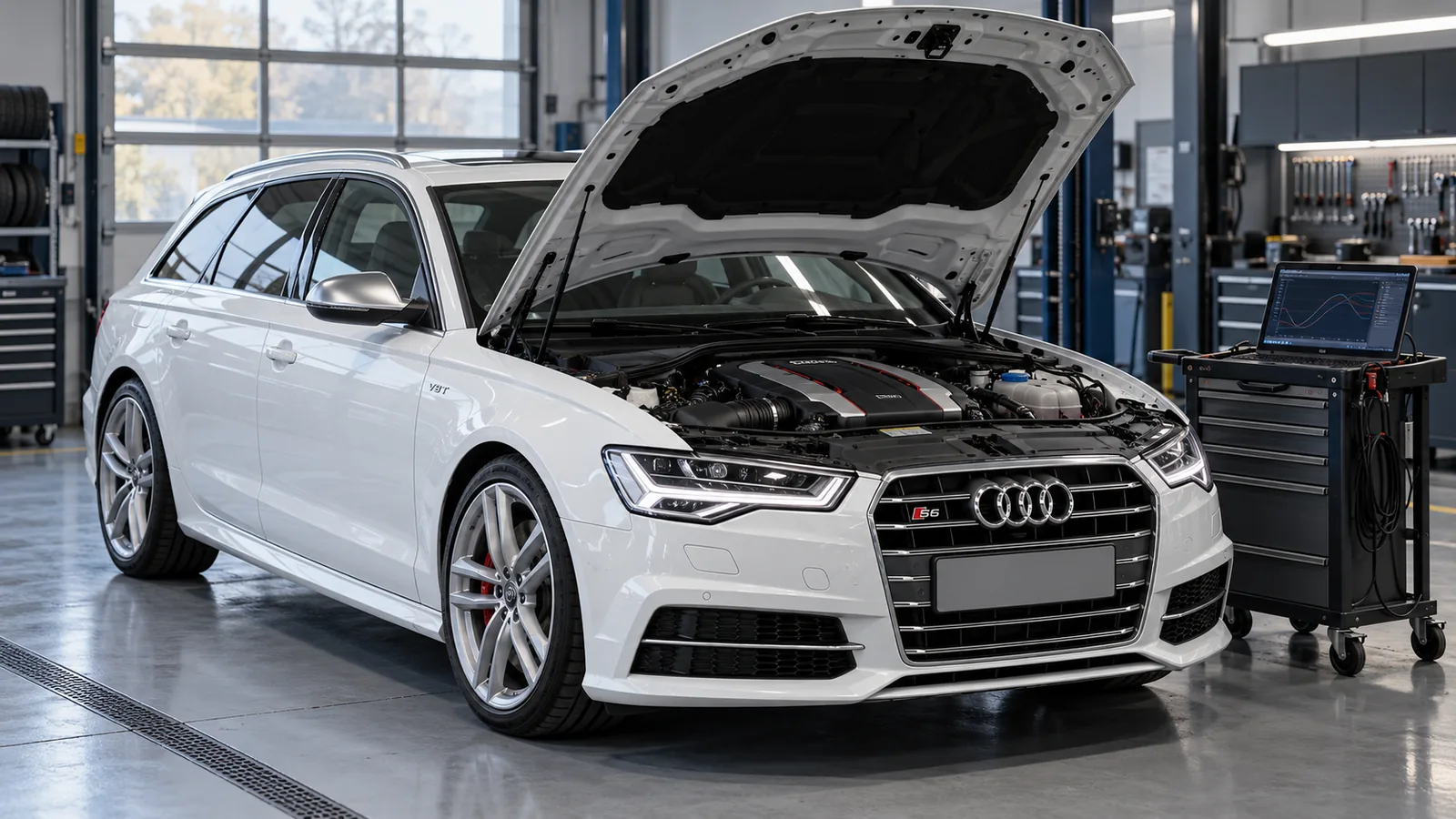
A used Audi S6 Avant bought for EUR 31,890, and later a car that could no longer be driven. In proceedings I conducted before the Regional Court of Linz, the dispute concerned alleged engine damage. The central question was which changes to the engine software had already been present before the purchase. The court-appointed expert found modifications to several protective functions, from the component-protection lambda settings to the rev limiter.
The software modifications in the state read from the control unit were established. Whether they had caused the engine damage remained unresolved without dismantling the engine. Following the hearing to discuss the expert report, the parties agreed on a settlement: EUR 25,000 in exchange for returning the car, plus reimbursement of litigation costs. The settlement, initially subject to a right of revocation, has now become legally effective. The case illustrates how technical findings, questions of evidence and an economically sensible solution are connected.
As a lawyer and trained motor vehicle mechanic, I assess such cases legally while also understanding engine management, diagnostics and damage patterns. For buyers, the important questions are: what does an expert report actually establish, and what further examination would be needed?
The vehicle: Audi S6 Avant, type 4G, with a 4.0-litre V8
My client bought the Audi from a vehicle dealer. According to the expert report, it was an Audi S6 Avant quattro, type 4G, with an engine capacity of 3,993 cm³. Its registered power output was 309 kW at 5,500 rpm, equivalent to around 420 metric horsepower. It was first registered in 2013. The manufacturer's data extract included in the report lists engine code CEUC and sales type 4G5S3Y. The technical overview uses the abbreviated engine designation CEU.
The purchase contract recorded 160,535 kilometres and a price of EUR 31,890. At a subsequent private damage assessment, the mileage was 166,156 kilometres, an increase of 5,621 kilometres. These figures describe only the period up to that assessment. They do not establish when damage began or what caused it.
At the court expert's inspection, the vehicle was not operational. The expert read the fault memory, examined the engine's interior using an endoscope and retained the engine control unit for further examination.
Bosch MED17.1.1: comparison with the factory software
The engine control unit was a Bosch MED17.1.1. The expert compared the extracted data with original reference software. This made it possible to identify deviations in the stored calibration maps.
A calibration map determines which value the engine management system uses under particular conditions, for example depending on engine speed and load. The modifications affected several functions that the manufacturer uses to protect the engine and exhaust system. Simply stating that “tuning is present” does not explain these findings. The individual findings are therefore set out below.
1. Component-protection lambda: reduced enrichment at high load
The expert found that, at higher engine speeds and loads, the mixture had been made leaner compared with the intended protection strategy. The factory enrichment was reduced in these operating ranges.
Lambda describes the ratio between the air actually present and the air required for complete combustion. Here, “made leaner” means that the mixture is leaner than in the factory calibration. It does not automatically mean that the engine was running with a lean mixture at a lambda value above 1 throughout.
According to the report, this modification increases exhaust gas temperatures. It can expose the turbochargers, catalytic converter, pistons and valves to greater thermal loads. This matters because the modified function is specifically intended to provide protection under demanding operating conditions.
2. Catalytic converter protection: modified temperature maps
The temperature maps for catalytic converter protection had also been edited. According to the report, this allowed the engine management system to permit higher exhaust gas temperatures than in the factory calibration. The catalytic converter protection strategy had been partly reduced.
This must be considered together with the modified mixture enrichment. The expert assessed several modifications whose effects on thermal loading may reinforce one another. The report contains no temperature measured during a test drive. The calibration-map analysis therefore does not establish a specific exhaust gas temperature.
3. Catalytic converter functions: disabled in the software
The report also describes modified deactivation maps and disabled catalytic converter control. Among other things, the software analysis shows switches for catalytic converter diagnostics with the states “1 = ON” and “0 = OFF”.
The expert regarded this as a substantial intervention in emissions-related protection and monitoring functions. It does not establish that the catalytic converter had been removed or its internal components taken out. Whether hardware had also been modified could not be conclusively determined during the examination.
4. Rev limiter: raised by 500 rpm
A particularly clear finding was that the engine rev limiter had been raised by 500 rpm. This changed an operating limit stored in the engine control unit.
The expert considered this an additional strain on rotating and reciprocating engine components. The altered limit permits higher engine speeds. The analysis does not show whether my client actually ran the engine up to that limit or whether this damaged a particular component.
5. Ignition maps: ignition timing advanced by up to 3°
In the ignition maps, the expert identified an advance of up to 3 degrees of crankshaft rotation compared with the reference calibration. Top dead centre is the highest point in the piston's travel. Ignition angles are expressed relative to that piston position.
“Advanced by up to 3°” means that ignition occurs earlier than in the factory calibration. It does not mean that the engine always fires at exactly 3° before top dead centre. The comparison in the report shows different changes depending on engine speed and load.
According to the report, these modifications may increase the tendency to knock, as well as thermal and mechanical loads. Again, a modification that may contribute to damage is not in itself an established cause of the particular damage in question.
What the fault memory and endoscope also revealed
The fault memory contained, among other entries, combustion misfires (P030000) and an entry for cylinder 7 (P030700). There were also entries relating to ignition control for cylinders 5 to 8 and several electrical faults affecting the camshaft adjustment actuators.
Context is crucial: when was a fault recorded? At what mileage? What work or checks had taken place beforehand? A fault code initially reports only a deviation detected by the system. It does not replace a mechanical diagnosis of damage and does not establish who caused a defect.
According to the report, the visual inspection with the endoscope revealed no clear damage inside the engine. The expert considered dismantling the engine necessary to establish specific mechanical damage and its cause. This did not take place during the proceedings. The significance of improperly installed wiring found in the engine compartment also remained unresolved.
A specific piston or valve defect has therefore not been established by the court as the cause of the damage. What has been established is software that differed from the factory state, with the modifications described above.
Was the tuning already present before the purchase?
The timing mattered for the dispute with the dealer. The documents examined by the expert contained indications of tuning as early as the period between 13 December 2021 and 16 May 2022, at mileages between 153,510 and 156,027 kilometres. The purchase contract was not concluded until 24 June 2023.
There were therefore specific indications of a tuning history before the purchase. However, the dealer disputed that the software complained of had been present or active at handover. My client denied making any changes to the engine software after handover.
During the supplementary discussion, the expert explained the limits of the examination. He could establish the state read from the control unit and the parameter deviations. A complete history of all software versions could not be reconstructed from this. He considered it theoretically possible that the software had been removed in the meantime and subsequently reinstalled. He had not established that such a sequence of events had occurred.
This distinction is central to my work as a lawyer. A theoretically possible alternative sequence is not an established fact. Conversely, an earlier indication of tuning cannot simply be assumed to apply to every setting read from the control unit at a later date.
Why “reinstalling the factory software” does not automatically resolve the case
The expert estimated the cost of restoring the engine software to its factory state at EUR 200 to EUR 300. However, this relatively small amount answered only part of the question: the cost of the software work.
Possible additional hardware modifications, mechanical damage and whether the car would have been fully usable again following reprogramming alone remained unresolved. Different software cannot, of course, repair components that are already damaged.
The valuation also had limits. Based on the circumstances established at the time, the expert estimated the vehicle's value when the contract was concluded at EUR 30,500. Engine damage that had not been conclusively examined and possible further modifications could not be taken into account. The report therefore did not confirm that the car had only scrap value.
“Unapproved tuning” is consequently not simply synonymous with a “worthless vehicle”. A reliable assessment of the claims requires separate consideration of the software state, approval issues, mechanical condition and the work needed to restore the vehicle.
My approach: translating technical questions into legal arguments
On behalf of my client, I sought cancellation of the purchase contract and repayment of the purchase price in exchange for returning the vehicle. The issues were the alleged engine damage, the undisclosed tuning and the condition the buyer was entitled to expect when concluding the contract.
Several legal questions had to be clarified: did the software modification, which had not been agreed, itself constitute a defect? What was the significance of the lack of approval? What remedy was possible and had been requested? And for which claims did it additionally need to be established that the tuning itself had caused mechanical damage? Not every finding of tuning automatically leads to reversal of the purchase.
The modifications established in the report also affected emissions and protective functions. The expert classified them as requiring approval; without the relevant documentation, he could not assess whether approval was possible at all. The legal framework for vehicle modifications is set out in section 33 of the Austrian Motor Vehicles Act (KFG).
My advantage as a trained motor vehicle mechanic is that I can put technical terminology and examination results into context. In proceedings, this helps me ask targeted questions. Does the analysis show a software deviation, an actual overload or already a damaged component? Has a cause been established or merely described as a possibility? What further examination would close a decisive gap?
As a lawyer, I must determine which arguments the available evidence supports and whether further examinations are economically worthwhile. The court-appointed expert's report remains an independent source of evidence. My technical training helps me use it critically and precisely when representing my client.
The settlement: EUR 25,000 in exchange for returning the Audi
After discussing the expert report, the parties concluded a settlement subject to a right of revocation. It provides for:
- Payment of EUR 25,000 to the buyer through his legal representative, concurrently with the return of the Audi S6 Avant.
- Collection of the vehicle from the buyer's home at the dealer's expense.
- An additional EUR 9,345.06 in reimbursement of the litigation costs agreed in the settlement.
The obligations must be performed within 14 days of the settlement becoming legally effective. The revocation period ended on 30 September 2026. As no revocation was received by the court, the settlement became effective.
Payment and the return of the vehicle are now to be completed within that period. The settlement does not establish that the tuning caused the engine damage.
For the buyer, the solution means returning the vehicle for a specified amount without having to continue litigating the unresolved technical questions of evidence. The settlement amount is below the original purchase price. This, too, is part of an accurate account. The difference cannot simply be characterised as compensation for use on the basis of the settlement.
What buyers can learn from this case
Where engine problems and suspected tuning are involved, it is important to preserve evidence of the actual condition. The following documents and information are particularly useful for an initial assessment:
- The purchase contract, advertisement and written assurances concerning the vehicle's condition.
- The mileage at handover, when the defects first appeared and at each examination.
- Complete diagnostic records with dates and mileage, as well as any available manufacturer checks relating to the software state.
- Workshop reports, maintenance records and documentation of subsequent repairs or software changes.
- The correspondence with the seller to date and the seller's response to the defects complained of.
Clarify how the existing data will be preserved before the fault memory is cleared, a software update is carried out or the control unit is replaced. Where there is a specific suspicion of damage, you should also obtain technical advice on continued use. Whether dismantling is necessary depends on the unresolved evidential question and the costs.
I explain the general requirements for returning a vehicle in the guide “Reversing a car purchase: returning a car because of defects”. For possible deductions for use of the vehicle, see the article on compensation for use when reversing a purchase.
Engine problems or suspected tuning after buying a car?
I review your purchase contract, correspondence and the available technical documents. We then discuss the claims and next steps that follow from them. I consider the legal questions and technical findings together.
For an enquiry, please send me the purchase contract, any workshop reports or expert reports and a brief account stating the purchase date, mileages and the problems that have arisen.
Contact: office@maydell-law.at · +43 1 2954251
Categories: Vehicle law
Tags: Vehicles, Reversal of a purchase, Rescission, Tuning

Mag. Patrick Maydell, LL.M.
Lawyer in Vienna.
Property law, vehicle law and inheritance law.