By Mag. Patrick Maydell, LL.M. – lawyer and trained motor mechanic
At a glance: A defect may entitle you to reverse a car purchase. When a consumer buys from a dealer, repair or replacement generally takes priority. Cancellation of the contract may be available, for example, where a remedy is refused or unsuccessful, or a defect is particularly serious. A merely minor defect is insufficient. In a private sale, it is also necessary to check whether statutory warranty liability was validly excluded.
What is wrong with the car – and what rights does that give you? As a lawyer and trained motor mechanic, I combine the technical and legal assessment.
Would you like to return your car because of a defect? Call me for a free initial telephone assessment on 01/2954251, or email office@maydell-law.at.
1. Can I return my car because of a defect?
A defect in the legal sense exists where the car does not have the agreed characteristics or meet the requirements that can reasonably be expected. For a used car, its age, mileage, price, description and disclosed damage are particularly relevant.
Wear consistent with the car’s age must be distinguished from a defect. However, a component subject to wear is not automatically excluded from statutory warranty protection: its condition must meet the agreed requirements and reasonable expectations.
Possible disputes include engine and gearbox damage, excessive oil consumption, serious corrosion, undisclosed accident damage or mileage that differs from what was represented. For electric cars, the agreed battery condition or specific range promises may also be relevant. A shorter range in winter does not, by itself, prove a defect.
Statutory warranty liability generally requires neither fault nor knowledge on the seller’s part. As a rule, the defect or its underlying condition must already have existed at delivery. Damage subsequently caused by misuse is not covered.
2. Buying from a dealer: must I first allow a repair?
Since 2022, the Austrian Consumer Warranty Act (VGG) has generally applied to car purchases by consumers from businesses. Older contracts and business purchases must be assessed separately. An additional commercial guarantee does not replace statutory warranty rights.
In principle, you may first request repair or replacement. Your choice is restricted if one option is impossible or disproportionately costly compared with the other. An equivalent replacement is not always possible for an individually specified used car, so repair is often the main remedy. The statutory order of remedies is set out in section 12 VGG.
The remedy must be provided within a reasonable time, free of charge and without significant inconvenience. There is no universal rule allowing two or three repair attempts in every case.
Notify the seller of the defect and, in principle, allow inspection and a remedy. Commissioning a repair on your own initiative may make claims and evidence more difficult. If the car cannot be driven, clarify transport arrangements and costs in advance.
3. When may I actually cancel the purchase contract?
In a consumer purchase from a dealer, moving to a price reduction or cancellation may be permitted, in particular, where:
- the defect is sufficiently serious to justify immediate cancellation;
- the dealer refuses to bring the car into conformity;
- the dealer’s statements or the circumstances show that the defect will not be remedied in time or without significant inconvenience;
- the remedy is not carried out properly or the reasonable period expires;
- a defect still occurs despite an attempt to repair it.
Cancellation is unavailable for merely minor defects; doubts as to whether a defect is minor are resolved against the business. In addition, one of the statutory grounds for moving to cancellation must be present. The legal basis is section 12(4) and (5) VGG.
Even with engine damage, therefore, the repair bill alone is not decisive. Available remedies, the dealer’s response and the burden caused by the repair also matter. There is no fixed monetary threshold for returning the car.
Under the VGG, cancellation of the contract, often also called Wandlung, takes effect by a declaration to the seller. For evidential purposes, make the declaration in writing and explain the reasons. If the seller objects, court proceedings may be necessary. Agree the return arrangements rather than simply leaving the car at the dealership.
4. Private purchases: what does “no warranty, no returns” mean?
Statutory warranty rights under the Austrian Civil Code (ABGB) generally also exist in private sales. However, private contracting parties can exclude them to a considerable extent. The precise contract wording, the advertisement and statements made before the purchase are therefore particularly important.
A comprehensive warranty exclusion may also cover hidden defects. The fact that you could not identify the damage during inspection does not, by itself, invalidate the exclusion. In principle, however, it does not cover characteristics expressly or implicitly assured, nor does it protect against the consequences of fraudulent concealment.
“No guarantee” and “no returns” do not necessarily exclude statutory warranty rights. They may refer to an additional commercial guarantee or a voluntary return arrangement. The interpretation of the agreement as a whole is decisive.
If the car was represented as accident-free, the precise scope of that statement and the actual previous damage must be examined. Not every advertisement contains a comprehensive assurance. Preserve the advertisement and messages early.
Where statutory warranty rights are available, the ABGB also generally requires repair or replacement to take priority, followed by price reduction or cancellation. Exceptions must be assessed under section 932 ABGB; the VGG rules cannot simply be applied unchanged to a private purchase.
Other possible grounds include avoidance for mistake, fraudulent misrepresentation or laesio enormis, a shortfall exceeding half the value. The latter generally requires the car’s value at the time the contract was concluded to have been less than half the purchase price. Under section 934 ABGB, the seller may avert cancellation by making the corresponding adjustment in value; section 935 ABGB contains exceptions. A high repair bill alone does not establish this value ratio.
5. Engine damage, electronic faults and accident damage: what matters?
The following three cases come from my practice and are presented without naming the parties. They illustrate how technical investigations can help clarify disputed vehicle defects. The first two cases are described in more detail in separate articles.
Case study 1: VW T5 Multivan with greatly increased oil consumption
A used VW T5 Multivan showed high oil consumption shortly after delivery. The dealer denied that a defect had existed at delivery and refused a repair. During court proceedings, a consumption test drive recorded oil consumption of 2.3 litres per 1,000 kilometres. The expert attributed the damage to worn cylinder bores and piston rings and considered that it had developed over a longer period.
The case illustrates how measurement can clarify the cause of damage and when it developed. Whether the expert’s report also supports cancellation requires a separate legal assessment.
I explain the case and the importance of the consumption test in VW T5: high oil consumption and refusal of statutory warranty remedies.
Case study 2: Hyundai Bayon with repeated battery discharge
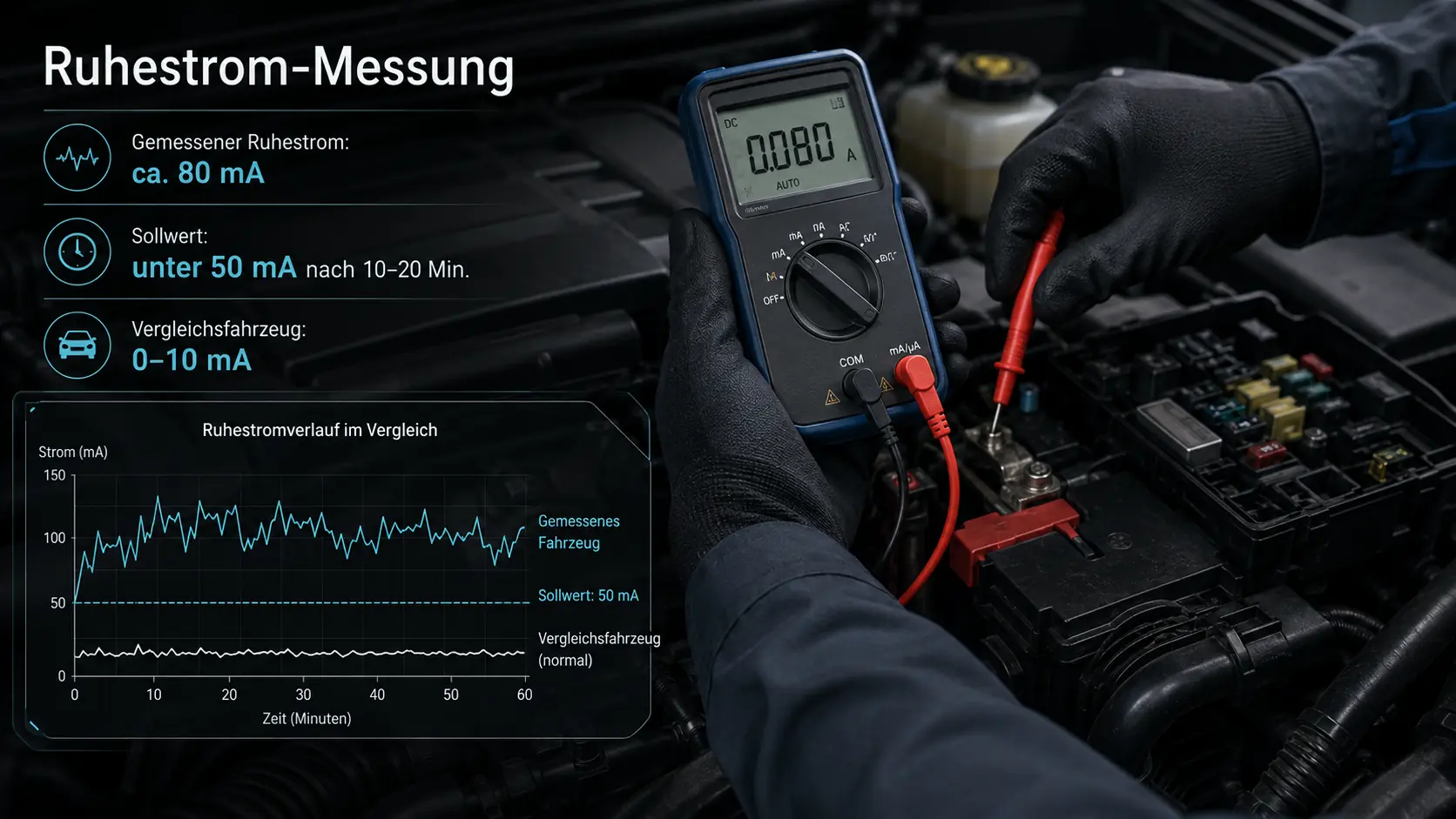
A Hyundai Bayon repeatedly failed to start after longer periods parked because its battery had discharged. Despite several battery replacements and other repairs, the cause remained disputed. The dealer and importer denied a technical defect during the proceedings. At the court-appointed inspection, a longer quiescent-current measurement showed unusual fluctuations, whereas a comparison vehicle reached a stable, low resting current.
A brief workshop check can miss an intermittent fault. The repair history, the circumstances in which the problem occurs and the measurement method are therefore important for the evidence. The published article describes the expert evidence in ongoing proceedings, not a successful reversal established by a final judgment.
More on the investigation and the procedural position described: Hyundai Bayon: repeated battery discharge and abnormal quiescent current.
Case study 3: undisclosed accident history of an Audi A5
In a case from my practice, a client bought a used Audi A5 Sportback from a private seller. On the very next day, an independent motor mechanic found indications of accident damage and repainting. My client alleged that the accident history had not been disclosed before the purchase, either in conversation or in the contract. In the proceedings, the seller relied, among other things, on an alleged exclusion of statutory warranty liability.
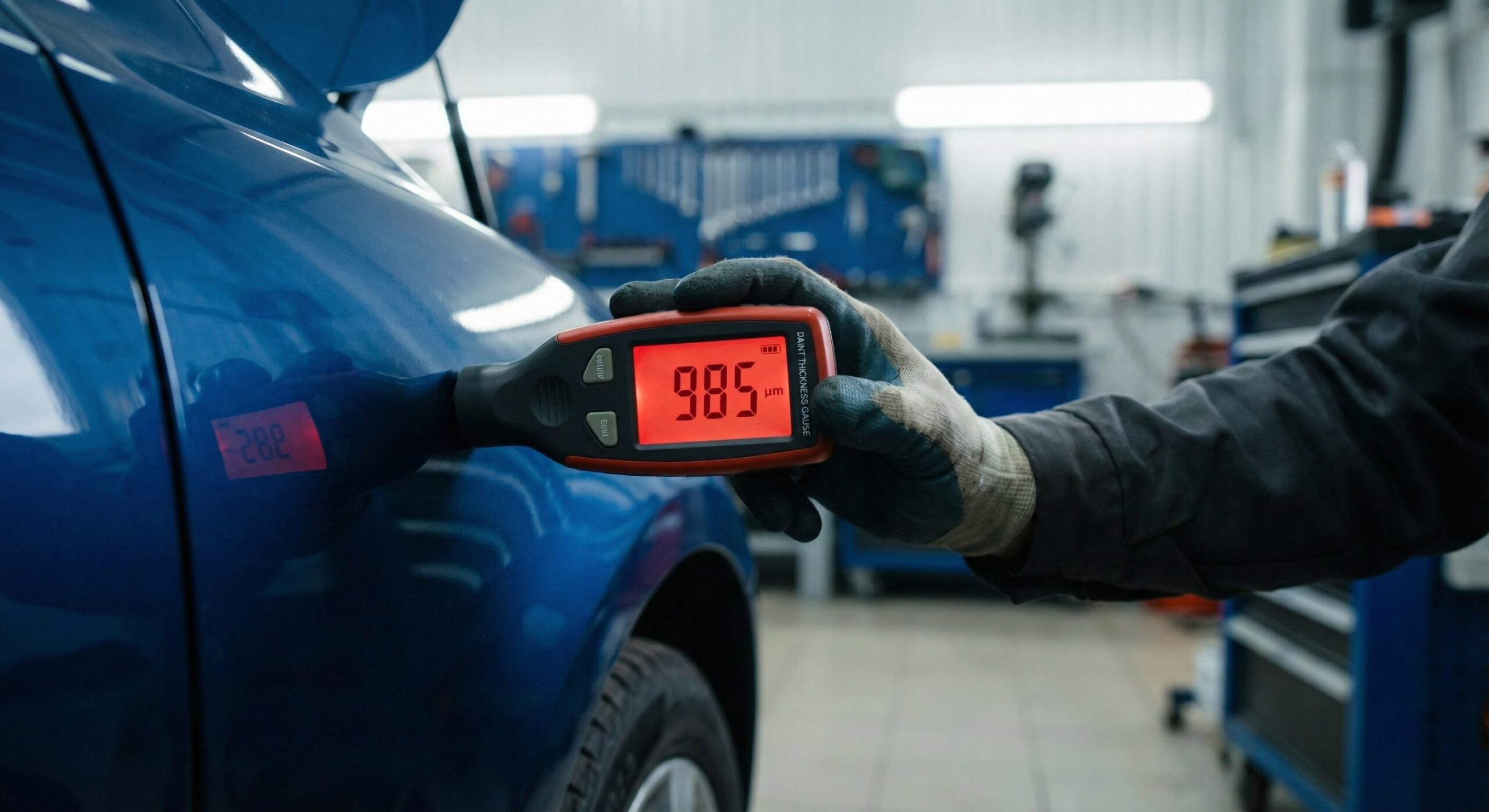
The court-commissioned expert’s report documented several instances of previous damage. Restoration costs exceeding EUR 11,000 were recorded for the most serious documented damage, affecting the left rear of the vehicle. On inspection, the expert also found extensive repainting and clearly inconsistent panel gaps. The assessment therefore drew on both the documented damage history and the vehicle’s actual condition on examination.
My client seeks cancellation of the purchase contract and repayment of the price against return of the car. The court must assess whether the seller fraudulently concealed the accident history; the technical findings alone do not decide that question. No final judgment was available in the case file reviewed.
6. Who must prove that the defect existed at delivery?
In a consumer purchase governed by the VGG, a defect that becomes apparent within one year after delivery is generally presumed to have existed at delivery. The presumption does not apply where it is incompatible with the nature of the goods or the defect. The seller may also rebut it.
You must be able to prove that a defect became apparent within that year. After that period, you generally also have to establish that the defect or its underlying condition existed at delivery. The presumption period must be distinguished from the statutory warranty period.
For private purchases under the ABGB, the statutory presumption period is generally six months. However, a valid warranty exclusion may already remove the basis for the claim.
Document the first symptoms as soon as they appear. Workshop visits, written complaints and photographs of warning messages help establish the sequence of events. Distinguish your observations from a cause of damage that has not yet been established.
7. What time limits apply to reversing the purchase?
A consumer purchase of a car is generally subject to a statutory warranty period of two years from delivery. For used vehicles, a reduction to one year is only valid if individually negotiated and more than one year has passed since first registration. A blanket statement such as “used cars: one-year warranty” is therefore not automatically sufficient.
Under section 28 VGG, statutory warranty rights and claims arising from price reduction or cancellation generally become time-barred three months after the relevant warranty period expires. This is not an additional period during which any new defect may first appear. Merely making a complaint does not automatically preserve the limitation period. Have the deadline checked in good time, particularly if discussions with the seller continue for a lengthy period.
For private purchases, the contract and any exclusions or agreed time limits must also be examined. Repairs, acknowledgements and other circumstances may affect the calculation of the applicable deadlines.
Change already enacted: for contracts concluded from 1 October 2026, the warranty period under the VGG is extended once by one year where a repair is carried out under section 12(2) VGG. The new rule does not apply generally to all older car purchases. Its basis is the Austrian Act implementing the Directive on the Repair of Goods (Warenreparaturrichtlinie-Umsetzungsgesetz).
8. How much money will I get back – and must I pay for mileage?
Where the contract is validly cancelled, the purchase is reversed: you return the car and the seller refunds the price. Under the VGG, the business bears the costs of return and may generally withhold repayment until it receives the vehicle or evidence that it has been sent back.
There may also be a dispute over compensation for using the car. Whether a deduction is justified, and in what amount, requires a separate assessment. Do not accept a dealer’s flat mileage charge without checking it.
For a mileage-based calculation, the purchase price, kilometres driven and expected remaining mileage at delivery are particularly relevant. The specific car’s condition and mileage matter. The amount refunded may therefore differ from the original purchase price.
I explain the calculation and common points of dispute in Usage compensation when reversing a car purchase.
Towing costs, diagnostic costs, repairs already paid for and other losses must each be assessed separately. Cancellation alone does not automatically make them recoverable. Where the purchase was financed, coordination with the credit agreement must also be clarified.
9. What should you do now?
- Avoid damage and danger: do not simply keep driving if warning signs appear or roadworthiness is in doubt. Obtain technical assistance and document the reason and the vehicle’s condition.
- Preserve documents: collect the purchase contract, advertisement, messages, delivery date, mileage readings, service records, invoices and workshop findings.
- Inform the seller in writing: describe the symptoms, when they first appeared and the steps already taken. Keep a verifiable record of receipt of your message.
- Clarify inspection and the remedy: in principle, allow an opportunity to inspect and provide the remedy owed. Where urgent action is needed, coordinate it beforehand if possible and document the urgency.
- Preserve evidence: avoid unnecessary disposal of removed parts or avoidable changes to the vehicle’s condition before securing evidence. An expert examination may be useful where there is a dispute.
- Check the claim, deadlines and costs: before a final cancellation declaration or settlement, establish what can be claimed and which course of action makes financial sense.
Four details are particularly helpful for an initial legal assessment: who sold the car, when it was delivered, what defect occurred and how the seller responded. Add the purchase price, mileage readings and any findings already available.
10. What does enforcing my claims cost?
Costs depend, among other things, on the amount in dispute, the extent of the legal work, the technical evidence and any court proceedings. In addition to legal fees, court fees and expert costs may arise.
A party who loses civil proceedings entirely must generally also reimburse the opposing party’s necessary litigation costs. Reimbursement follows statutory rules and tariffs; it does not necessarily cover every expense actually agreed.
Legal expenses insurance may cover costs depending on the policy. Before taking steps that incur costs, clarify cover, any excess and possible exclusions. Having a policy does not mean that every dispute is automatically covered.
Whether a repair, price reduction, settlement or court proceedings make sense therefore depends not only on the legal position, but also on the evidence and the financial outcome.
Lawyer and motor mechanic: assessing your case legally and technically
I assess the contract documents and technical findings together: which claims may be available, what evidence is missing and what course of action makes sense?
My training as a motor mechanic helps me identify the decisive technical questions. It does not replace an expert’s report where one is required.
Would you like to have your options assessed? Contact me for a free initial telephone assessment. The document checklist above will help you prepare.
Mag. Patrick Maydell, LL.M. · Lawyer and trained motor mechanic
Telephone: 01/2954251 · Email: office@maydell-law.at
Neustiftgasse 17/1/9, 1070 Vienna
Frequently asked questions about buying a defective car
Can I return a used car to a dealer?
Yes, where there is a defect for which the dealer is liable and the requirements for cancellation are met. Often, an opportunity to provide a remedy must be given first.
Can I withdraw even though I have signed the purchase contract?
Yes, statutory rights relating to defects exist even after a contract has been signed. A mere change of mind, however, generally does not entitle you to withdraw.
Is there a 14-day right of withdrawal when buying a car?
There is no general 14-day right of withdrawal for an ordinary purchase at a dealership or from a private seller. Such a right may exist under section 11 of the Austrian Distance and Off-Premises Contracts Act (FAGG) for distance contracts or consumer contracts concluded away from business premises, subject to statutory exceptions. Finding an advertisement online does not, by itself, make a purchase subsequently concluded at a dealership a distance contract.
Is engine damage enough for an immediate reversal?
Not automatically. The cause, severity and available remedies are decisive. A particularly serious defect may justify immediate cancellation in a consumer purchase.
How many times must I let the dealer repair the car?
There is no fixed number applicable to every case. The statutory requirements, the particular defect and the course of previous remedial work are decisive.
Do I have rights in a private purchase despite a warranty exclusion?
That may be the case, for example, where assured characteristics are missing or damage was fraudulently concealed. However, a comprehensive exclusion may also cover hidden defects. The contract, advertisement and assurances must be considered together.
Who must prove that the defect already existed when the car was bought?
Delivery is generally the decisive point. The VGG generally provides a one-year presumption period, and the ABGB generally provides six months. The requirements, exceptions and possibility of rebuttal must still be considered.
How much is usage compensation?
That depends on the legal basis of the claim and the circumstances. In a mileage-based calculation, the distance driven and expected remaining mileage are particularly important. Check any proposed deduction before agreeing to it.
Mag. Patrick Maydell, LL.M., Lawyer
Neustiftgasse 17/1/9
1070 Vienna
Telephone: 01/2954251
office@maydell-law.at