

VW ID.3, ID.4, ID.7, ID. Buzz and Cupra Born: battery recall – your rights in Austria
By RA Mag. Patrick Maydell, LL.M. | Lawyer and trained vehicle mechanic | Updated: 3 November 2026
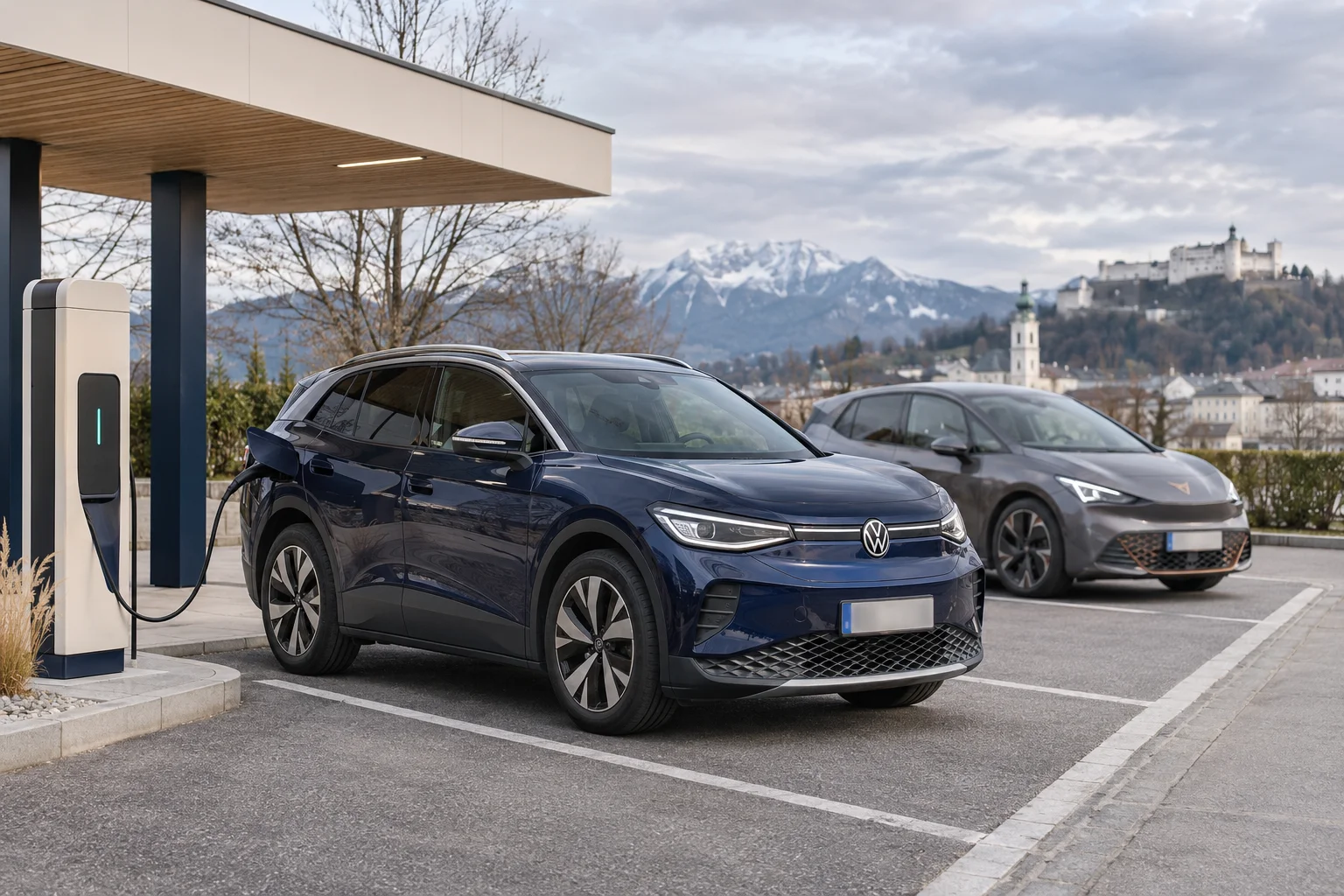
A battery recall with an 80 per cent charge limit can significantly change everyday life with an electric car. Certain VW ID. models and Cupra Born vehicles are affected by possible high-voltage battery defects and a fire risk. I explain what the limit means, which documents matter and when claims against the seller may arise.
The key points
- Specific vehicles are affected, not every car in a model range. Have the current recall status checked using the vehicle identification number (VIN).
- A prescribed 80 per cent charge limit must be observed. It restricts the usable charging range but does not, by itself, establish a permanent loss of 20 per cent of battery capacity.
- For Austria, MeinBezirk reported on 16 October 2026, citing information it obtained from Porsche Holding Salzburg, that around 650 VW ID. vehicles and 200 Cupra Born vehicles were affected. These figures reflect the position at that time.
- A recall does not automatically entitle you to return the car. The specific defect, the remedy and the requirements of the relevant legal basis are decisive.
- The seller must remedy the defect within a reasonable time. An update date announced by the manufacturer does not determine that period.
- Keep purchase documents, recall letters and workshop reports. Have deadlines checked using your contract and delivery date; the production year alone is not decisive.
What the recall concerns
Published manufacturer information describes quality deviations in certain high-voltage batteries. At high charge levels, overheating and even fire may occur. Since October 2026, Germany's Federal Motor Transport Authority (KBA) has listed three recalls: 93MF and 93MV for VW ID.3, ID.4, ID.7 and ID. Buzz vehicles produced between July 2022 and June 2025, and 93W4 for Cupra Born vehicles produced between September 2022 and May 2024. The KBA describes non-compliant high-voltage batteries with overlapping cells that may overheat, particularly during rapid charging. According to these figures, around 72,700 vehicles are affected worldwide. The relevant brand partner must clarify whether your specific vehicle is affected using its VIN.
Models and production periods listed in the German recall database and foreign manufacturer information do not necessarily constitute a complete list for Austria. For Austrian owners, the current recall letter and vehicle-specific information from their VW or CUPRA partner are decisive.
Different campaign codes and earlier recalls should not be treated as identical. Volkswagen UK publishes information on 93MF and 93MV; CUPRA UK on 93W4. A previous workshop visit therefore does not establish that all currently relevant measures have been completed. Obtain written confirmation of outstanding and completed campaigns for your VIN.
The purpose of the charge limit and the remedy process
According to the manufacturers, the limit is intended to reduce battery stress and increase the safety margin until the remedy is completed. It is a temporary protective measure and does not eliminate the underlying cause.
On their British recall pages, Volkswagen and CUPRA describe inspections, a later software measure and replacement of battery modules where necessary. Once all required work has been completed, the original charging and range parameters are to be restored there. The procedure and timing for Austria must be confirmed for the individual vehicle. A foreign announcement is not a binding repair commitment for your car.
After a workshop visit, obtain written confirmation of the campaign and inspection performed, the findings and any continuing usage restrictions. Ask for available diagnostic or inspection reports. Work on high-voltage systems must be carried out exclusively by appropriately qualified specialists.
What the 80 per cent limit means in everyday use
A charge limit may require more frequent charging stops and additional planning. The effect on everyday range depends on driving style, temperature, route and previous charging habits, among other factors. An “80 per cent” display therefore does not establish a standard percentage loss of range.
Legally, the question is whether the vehicle meets its agreed and objectively expected characteristics. These include safety and usability in accordance with the contract. The reason for a charge limit, its duration and its specific effects matter, as does the availability of a permanent remedy. A single snapshot of the range display will usually be insufficient.
A recall does not automatically mean reversal of the purchase
A free recall measure serves product safety. Whether it also restores the condition required under the purchase contract must be assessed separately. In particular, distinguish between:
- Statutory warranty: your claim is generally against the seller. The Austrian Consumer Warranty Act (VGG) generally applies to consumer purchases from businesses under contracts concluded on or after 1 January 2022. Older contracts and private purchases require separate assessment.
- Manufacturer's guarantee: this is an additional promise governed by its own terms. Whether it covers a battery defect or a minimum capacity must be checked against the particular guarantee documents. A guarantee does not replace statutory claims against the seller.
Statutory warranty: rights and deadlines
Under the VGG, the warranty period for a consumer purchase is generally two years from delivery. A material defect existing at delivery must become apparent within that period. For used vehicles, a reduction to one year is effective only if individually negotiated and more than one year has passed since first registration (section 10(4) VGG).
If a defect becomes apparent within one year of delivery, it is generally presumed to have existed at delivery (section 11 VGG). This presumption does not apply if incompatible with the nature of the goods or defect. Section 924 ABGB, by contrast, contains a six-month presumption period. The applicable rule depends on the governing law.
The warranty period and the limitation period must be distinguished. Under section 28 VGG, warranty rights generally become time-barred three months after the relevant warranty period ends. These additional months do not extend the period within which the material defect must first become apparent. A complaint letter alone does not automatically preserve claims against limitation.
For contracts from 1 October 2026, a one-off extension of the warranty period by one year additionally applies where a repair under the statutory warranty restores conformity (section 10(2a) VGG). Before the remedy, the trader must inform the consumer of the choice between repair and replacement and this possible extension (section 12(2a) VGG). This does not apply generally to older purchases or every manufacturer measure.
Repair or replacement generally takes priority. The consumer may choose between them unless the chosen remedy is impossible or disproportionately costly compared with the alternative. Under certain conditions, section 12 VGG permits a switch to a price reduction or contract termination, for example where the remedy is refused, delayed or unsuccessful. A particularly serious defect may justify an immediate price reduction or termination. Contract termination is excluded for merely minor defects.
How long you must wait is a central question. The seller must repair or replace within a reasonable time after being notified and without significant inconvenience to you (section 13(1) VGG). What is reasonable depends, among other things, on the nature of the goods and your intended use. An update date announced by the manufacturer does not determine this period. Your claim is against the seller. Where the remedy is unreasonably delayed or use is substantially restricted in the meantime, a price reduction or contract termination may become an option. Notify the seller in a provable manner so that the start of the period can be established.
The production year does not show whether claims have become time-barred. In particular, the contract date, delivery, when the defect became apparent and previous remedial measures matter.
Damages claims may also require examination. Section 933a ABGB requires, in particular, fault on the part of the transferor; the burden-of-proof rules require separate consideration. Damages are therefore not an automatic substitute for an expired warranty. A three-year limitation period generally runs from knowledge of the damage and the responsible person (section 1489 ABGB); its starting point must be determined individually.
In its decision of 27 May 2014, 9 Ob 14/14w, the Austrian Supreme Court confirmed that a buyer may seek reversal through damages for defects attributable to the seller's fault where repair or replacement is not an option. The case concerned a used car that was not safe for road use and operation and had additional defects, not a battery recall of an ID. model or Cupra Born.
When assessing reversal, the following questions are particularly important:
- Which contractual characteristics and specific impairments can be proved?
- What remedy was offered or attempted, when will a permanent solution be available, and which restrictions remain until then?
- Are the statutory requirements for contract termination or reversal through damages met?
- Which law applies, and are the claims still enforceable?
Successful reversal generally involves returning the car in exchange for repayment of the purchase price. Usage compensation may reduce the refund. Whether and how it is calculated depends on the legal basis and the particular vehicle. Have the likely deduction assessed before deciding on reversal.
What you should do now
- Clarify recall status: retain the letter and have outstanding campaigns checked by VIN at a VW or CUPRA partner. Observe current charging and usage instructions.
- Keep purchase documents: contract, invoice, delivery date, advertisement or brochure, and specific promises about the battery and range.
- Document the effects safely: record mileage, current charge limit, warnings and additional charging stops. Existing older records may provide a comparison. Do not charge above a safety limit to gather evidence.
- Retain workshop documents: work order, measures carried out, diagnostic results and written information on remaining restrictions and further appointments.
- Have waivers checked: clarify the meaning of any settlement or waiver before signing.
- Notify the seller in a provable manner and request a remedy: consumers generally do not have a commercial inspection and notification duty such as that under section 377 UGB. Prompt written notification nevertheless remains useful.
- Clarify legal expenses cover: have your insurer's cover for the intended proceedings checked.
- Check deadlines independently of the recall: a workshop appointment or correspondence with the manufacturer does not automatically prevent limitation.
Frequently asked questions
I have not received a letter. Could I still be affected?
The absence of a letter alone does not establish that you are unaffected. Have the current status checked by VIN with the relevant brand partner, particularly following a change of owner or previous recall measures.
May I charge normally until the inspection?
If an 80 per cent charge limit applies to your vehicle, observe it until it is lifted under the relevant manufacturer instructions. Do not bypass a safety limit yourself. In the event of warnings or uncertainty, obtain professional advice on whether and how the vehicle may continue to be used.
Am I entitled to a replacement car or compensation for the charge limit?
No general manufacturer commitment for Austrian owners is currently known. Ask the seller for a specific solution and record provable additional costs. Whether replacement mobility, reimbursement or a price reduction can be claimed depends on the legal basis and circumstances. An 80 per cent charge limit does not automatically justify a 20 per cent price reduction.
Support in disputes with sellers or manufacturers
I assist vehicle owners in Vienna and throughout Austria with warranty, damages and purchase reversal matters. Send me your purchase contract, recall letter and available workshop documents for a free, non-binding initial assessment. If you have legal expenses insurance, I will be happy to clarify cover for the intended proceedings.
Contact: office@maydell-law.at | +43 1 2954251 | Neustiftgasse 17/1/9, 1070 Vienna
Further reading
- Jaguar I-PACE: recall, charge limit and purchase reversal
- Supreme Court: reversing an electric car purchase when the promised range is not achieved
- Usage compensation when reversing a car purchase
Sources
- MeinBezirk, 16 October 2026: information from Porsche Holding Salzburg on around 650 VW ID. vehicles and 200 Cupra Born vehicles in Austria.
- Volkswagen UK: manufacturer information on battery campaigns 93MF and 93MV. Procedures and information relate to the British market.
- AUTOHAUS: KBA recall information for 93MF, 93MV and 93W4, including production periods, numbers and defect description. These figures come from the German recall database and do not confirm the situation in Austria.
- CUPRA UK: manufacturer information on battery campaign 93W4. Procedures and information relate to the British market.
About the author
RA Mag. Patrick Maydell, LL.M. is a lawyer in Vienna handling vehicle purchase reversals, warranty and damages matters. As a trained vehicle mechanic, he combines legal assessment with technical understanding of recall letters, diagnostic reports and workshop documents.
This article does not replace individual legal advice.
Categories: Vehicle law
Tags: Cancelling an electric car purchase, Defect, Reversal of a purchase

Mag. Patrick Maydell, LL.M.
Lawyer in Vienna.
Property law, vehicle law and inheritance law.